




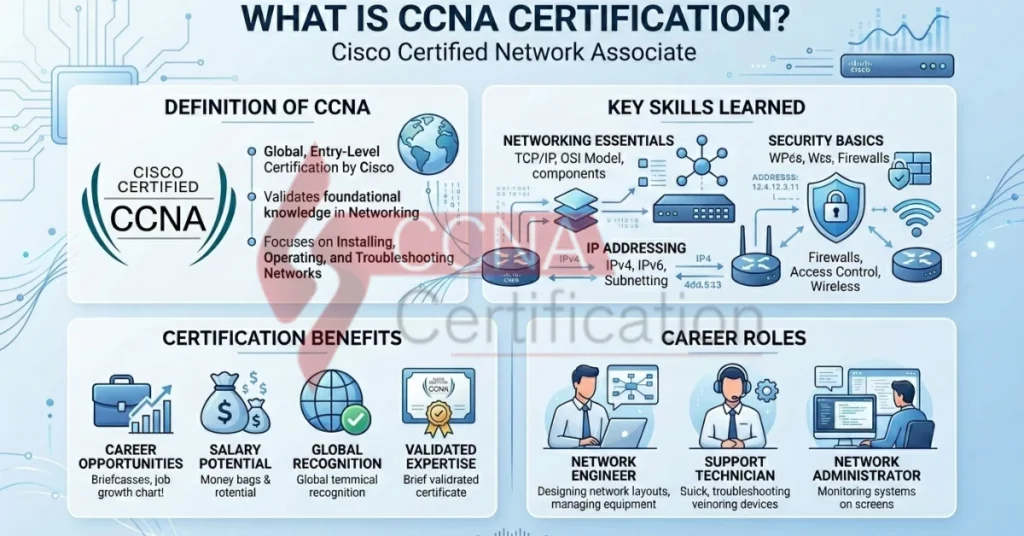
CCNA stands for Cisco Certified Network Associate. This is a widely accepted networking certification offered by Cisco Systems, which confirms that you have the skills needed to manage, implement, and troubleshoot enterprise networks ranging from small to medium sized. If you wish to establish yourself in an IT networking career in Australia, the CCNA certification will undoubtedly be among the best and most relevant certifications for you to attain. This certification includes knowledge in networking fundamentals such as IP address configuration, routing, switching, network security, and automation.
Why Australian IT Professionals Choose CCNA
The requirements for network engineers in Australia are stable and increasing. As per the Jobs and Skills Australia, ICT Network and Support Engineers have been listed among the highly demanded jobs in Australia especially in sectors such as the government, health care, banking, and telecommunication.
Your career can take off from the moment you get your CCNA certificate. Your prospective employer will be aware that you know about how things work in actual network operations rather than theory. Irrespective of whether you reside in Melbourne, Sydney, Brisbane or Perth, getting a CCNA certification gives you access to managed service providers, corporate IT departments, and government organizations. Are you interested in developing your networking abilities and taking up Cisco certification? Then you should consider joining our CCNA course in Adelaide, which includes both practical sessions and professional assistance.
What Does the CCNA Exam Cover?
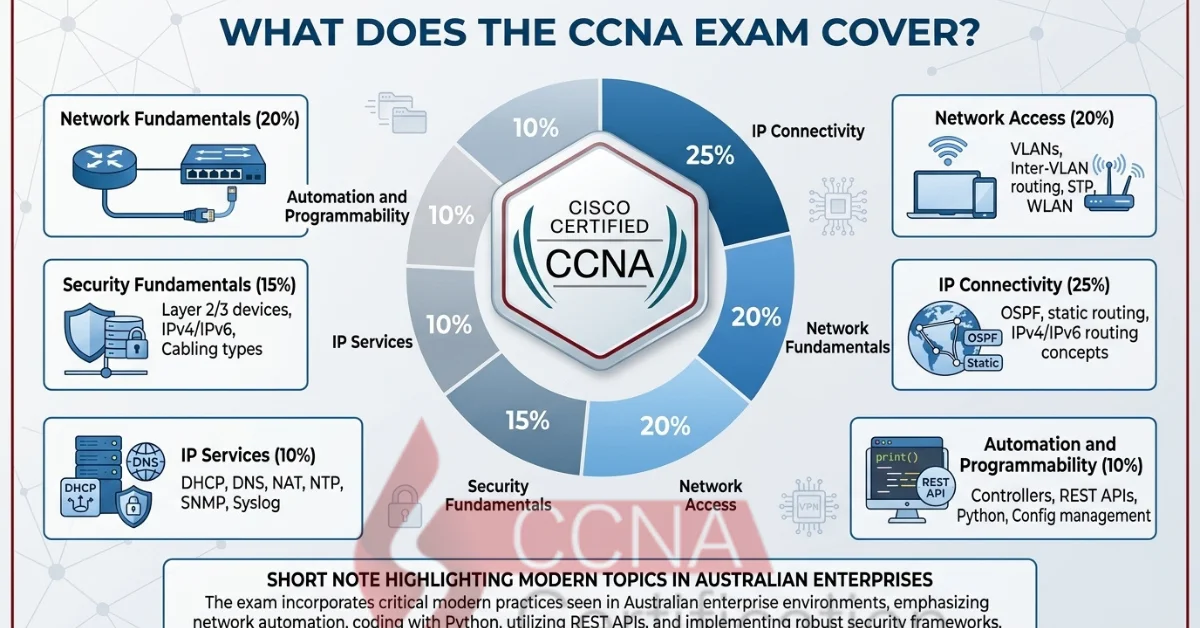
There is only one test included in the current CCNA exam (200-301). The content covered in this test varies greatly. Below is the list of areas covered by the CCNA Exam:
| Exam Domain | Approximate Weighting |
| Network Fundamentals | 20% |
| Network Access | 20% |
| IP Connectivity | 25% |
| IP Services | 10% |
| Security Fundamentals | 15% |
| Automation and Programmability | 10% |
This implies that the CCNA covers topics such as network automation and programmability using languages like Python and REST APIs, among other contemporary topics that pertain to the current state of network operations at Australian businesses.
Who Should Sit the CCNA Exam?
The CCNA Exam is designed for anyone who wants to work in or advance within IT networking. You do not need a university degree to sit the exam. You also do not need any prerequisite certifications. It suits:
- School leavers wanting a direct pathway into IT without a four-year degree
- IT helpdesk professionals ready to move into network support roles
- Career changers from unrelated industries who want to enter tech
- Systems administrators who want to formally validate their networking knowledge
The exam suits people who prefer practical, vendor-specific skills over theoretical academic study. It is also a strong entry point if you plan to eventually pursue higher Cisco certifications like CCNP or CCIE.
CCNA Exam Format and What to Expect
The CCNA 200-301 exam runs for 120 minutes and contains between 95 and 105 questions. Question types include multiple choice, drag-and-drop, fill-in-the-blank, and simulation-based tasks where you configure a virtual network device.
The passing score is 825 out of 1000. Cisco uses a scaled scoring model, so the exact number of correct answers needed can vary slightly between exam versions.
You sit the exam at a Pearson VUE testing centre. There are authorised centres across Australia in all major cities, or you can sit it online with remote proctoring from your home or office.
How Much Does the CCNA Cost in Australia?
The exam voucher for CCNA 200-301 is priced in USD by Cisco, which translates to approximately AUD $480–$530 depending on the current exchange rate. This is the exam-only cost.
Training costs vary depending on the provider and format:
| Training Format | Estimated AUD Cost |
| Self-study (books + practice tests) | $100 – $300 |
| Online video courses | $200 – $800 |
| Instructor-led classroom training | $1,500 – $3,500 |
| Bundled training + exam voucher | $2,000 – $4,000 |
Instructor-led training tends to produce better results for people who are new to networking, particularly when lab practice is included. It shortens study time significantly and reduces the risk of sitting the exam unprepared.
CCNA vs Other Entry-Level IT Certifications
Many Australians compare the CCNA against CompTIA Network+ when deciding which path to take. Both cover networking fundamentals, but they serve slightly different purposes.
| Feature | CCNA | CompTIA Network+ |
| Vendor | Cisco (vendor-specific) | CompTIA (vendor-neutral) |
| Difficulty | Higher | Moderate |
| Industry Recognition in AU | Very high | High |
| Job Role Focus | Network engineer, network admin | General IT support |
| Renewal Required | Every 3 years | Every 3 years |
The CCNA carries more weight in environments where Cisco equipment is used — which covers the majority of enterprise and government networks in Australia. If your goal is to work specifically in networking rather than broad IT support, the CCNA is the stronger choice.
How Long Does It Take to Get CCNA Certified?
Study time varies depending on your existing knowledge. Someone with no networking background typically needs 3 to 6 months of consistent study. Someone already working in IT support may be ready within 6 to 12 weeks.
The most effective preparation combines:
- Structured learning from an authorised training provider
- Hands-on lab practice using Cisco Packet Tracer or physical equipment
- Regular review using practice exams to identify weak areas
Rushing the preparation is one of the most common reasons candidates fail. The exam includes simulation questions that require genuine hands-on experience, not just memorised theory.
What Jobs Can You Get With a CCNA in Australia?
The CCNA is a hiring signal for a range of networking and infrastructure roles. Common job titles for CCNA holders in Australia include:
- Network Engineer — AUD $75,000 to $110,000
- Network Administrator — AUD $65,000 to $95,000
- Junior Network Analyst — AUD $55,000 to $75,000
- NOC Technician — AUD $60,000 to $85,000
- Systems/Network Support Engineer — AUD $70,000 to $100,000
Salary data is indicative and sourced from publicly available Australian job listing platforms. Pay scales vary by city, employer size, and years of experience.
Many CCNA holders use the certification as a stepping stone into more senior roles. With 2 to 3 years of experience and a CCNP, earning over AUD $120,000 annually is realistic in major Australian cities.
How to Maintain Your CCNA Certification
The CCNA is valid for three years from the date you pass. To keep it active, you have two options:
- Pass a higher-level Cisco exam (such as the CCNP) before the three-year period ends — this automatically renews your CCNA.
- Earn Continuing Education (CE) credits through Cisco’s online learning platform and submit them before expiry.
Letting your CCNA lapse means you need to resit the full exam. Most working professionals find it easier to stay current through CE credits or by progressing to the CCNP naturally as their career advances.
Ready to Start Your CCNA Journey?
If you are serious about building a networking career in Australia, now is the right time to take the first step. The CCNA is one of the best returns on investment in the IT certification space — it is recognised by employers nationally, covers skills that are directly applicable on the job, and opens pathways to higher-paying roles.
CCNA Certification Australia offers instructor-led CCNA training in Melbourne with real lab environments, small class sizes, and experienced trainers who hold active Cisco certifications themselves. Our students leave prepared — not just to pass the exam, but to perform in the role.
📞 Call us on 1300 649 299 to speak with a training advisor about the next intake. 📍 Suite 3, 53 Dryburgh Street, West Melbourne VIC 3003
Frequently Asked Questions
FAQ 1: Is CCNA certification worth it in 2026?
Yes, the CCNA is worth it in 2026. Australian employers in networking, government, and enterprise IT actively hire CCNA-certified professionals. Entry-level roles start around AUD $65,000 and grow quickly with experience. It is one of the best-value IT certifications you can hold right now.
FAQ 2: How long does it take to get CCNA certified?
Most people get CCNA certified within 3 to 6 months. If you already work in IT, 8 to 12 weeks of focused study is realistic. The timeline depends on how much time you commit each week and whether you include hands-on lab practice alongside your study.
FAQ 3: What are the requirements to get a CCNA certification?
There are no formal requirements to sit the CCNA exam. No degree, no previous certification, and no minimum work experience is needed. Cisco recommends at least one year of networking experience, but anyone can register and sit the exam at any time.
FAQ 4: How much does the CCNA exam cost in Australia?
The CCNA exam costs approximately AUD $480 to $530, depending on the current exchange rate. This is the exam voucher cost only, paid through Pearson VUE. Training costs are separate and range from $100 for self-study materials up to $3,500 for instructor-led courses with lab access.
FAQ 5: What jobs can I get with a CCNA in Australia?
With a CCNA, you can apply for roles such as Network Engineer, Network Administrator, NOC Technician, and Network Support Engineer. These roles pay between AUD $65,000 and $110,000 across Australia. Managed service providers, government agencies, and enterprise IT teams are the biggest hirers.
FAQ 6: What is the difference between CCNA and CCNP?
The CCNA is the entry-level Cisco certification covering core networking fundamentals. The CCNP is the next level up, covering advanced enterprise, security, or data centre networking. Most Australian professionals pursue the CCNP after gaining 2 to 3 years of work experience with their CCNA.
For structured CCNA training with qualified instructors, contact CCNA Certification Australia on 1300 649 299 or visit us at Suite 3, 53 Dryburgh Street, West Melbourne VIC 3003.