


If you are looking for a CCNA course Australia, the short answer is this: it is a vendor-specific Cisco certification program that teaches you how to install, configure, and troubleshoot network infrastructure — and it is one of the most respected entry-level networking qualifications you can hold in the Australian IT job market today.
What Is a CCNA Certification?
The Cisco Certified Network Associate (CCNA) certification validates your ability to work with IP networks, routing and switching, network security fundamentals, and automation basics. Cisco redesigned the CCNA in 2020, merging over a dozen specialisation tracks into one consolidated exam — the 200-301 CCNA.
This single exam now covers a broader range of skills than the old track-based model. That makes it more relevant to real-world Australian networking roles, where engineers are expected to handle multiple functions across wired, wireless, and security domains.
Who Should Do a CCNA Course in Australia?
The CCNA suits people who are:
- Working in IT support or helpdesk roles, and want to move into networking
- Recent graduates from IT or computer science degrees, looking to add vendor credentials
- Career changers transitioning into the technology sector
- Network administrators who have been working without formal certification
There is no official prerequisite for the CCNA exam, but Cisco recommends at least 12 months of hands-on networking experience before taking it. A good training course can significantly help bridge that gap.
Core Topics Covered in the CCNA 200-301
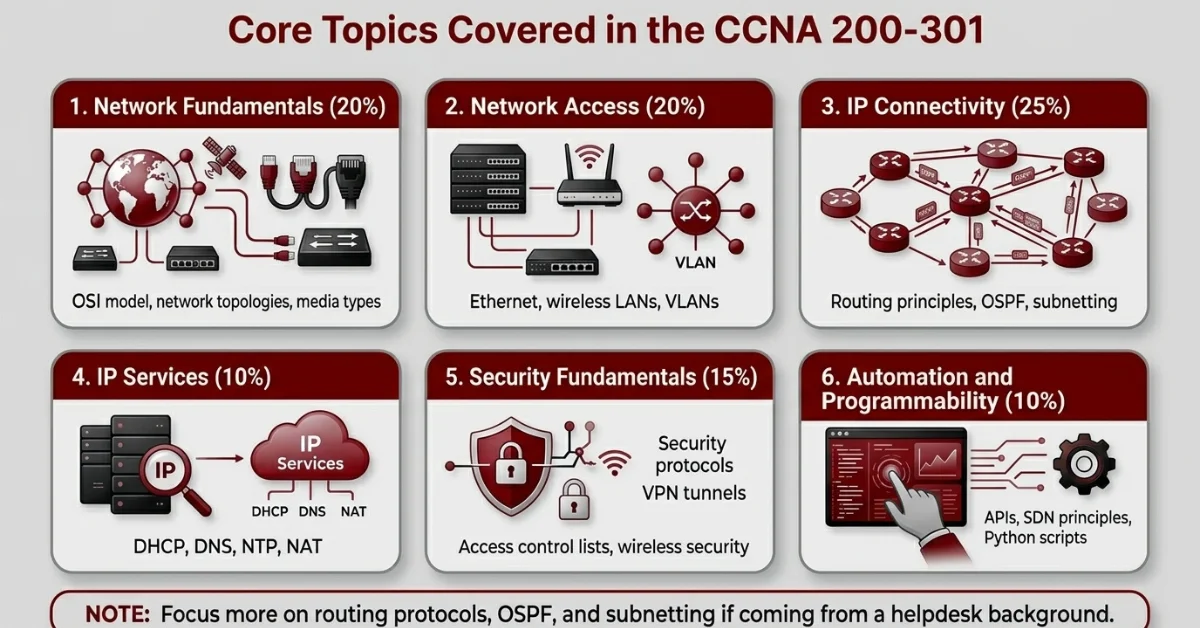
The CCNA 200-301 exam covers six main domains. Understanding these before you enrol helps you choose the right training format.
| Domain | Exam Weighting |
| Network Fundamentals | 20% |
| Network Access | 20% |
| IP Connectivity | 25% |
| IP Services | 10% |
| Security Fundamentals | 15% |
| Automation and Programmability | 10% |
The heaviest sections are IP connectivity and network fundamentals. If you are coming from a helpdesk background, plan to spend more time on routing protocols, OSPF, and subnetting before your exam date.
CCNA Training Formats Available in Australia
Australian learners can choose from several training delivery styles depending on their schedule, budget, and learning preferences.
Classroom-based training is the most structured option. You attend scheduled sessions with an instructor and other students, which works well if you prefer accountability and real-time Q&A. Sydney and Melbourne have the widest range of scheduled class intakes.
Online self-paced courses give you full flexibility to study around work and family commitments. These are popular across regional Australia, where in-person options are limited. The trade-off is that you need to stay self-motivated through the material.
Blended learning combines online pre-reading with scheduled virtual or in-person instructor-led sessions. Many providers in Australia now offer this as their default delivery model because it balances flexibility with structured support.
Boot camps compress CCNA training into an intensive format — typically five to seven days of full-time study. They suit people who want to fast-track certification or have taken time off work for study.
How Long Does CCNA Training Take?
Most people completing a structured CCNA course Australia spend between 60 and 120 hours of total study time before they are exam-ready. The actual calendar time depends heavily on your delivery format and existing experience.
| Experience Level | Typical Study Timeline |
| No networking background | 4 to 6 months |
| Helpdesk / IT support experience | 2 to 4 months |
| Existing networking exposure | 6 to 10 weeks |
These are averages. Some learners move faster, particularly those who work in networking daily and are formalising existing knowledge.
Lab Practice: Why It Matters More Than Theory
Passing the CCNA is not just about memorising theory. Cisco’s exam includes simulation questions where you configure live network devices in a virtual environment. If you have never touched a Cisco IOS command line before exam day, you will struggle with these questions regardless of how much theory you know.
Good CCNA courses in Australia give you access to either physical lab equipment or simulation software such as Cisco Packet Tracer. Packet Tracer is Cisco’s free network simulation tool, and it is sufficient for most CCNA lab practice. Some courses also include access to real hardware racks, which is closer to what you will encounter in actual networking roles.
Before enrolling, ask the provider specifically what lab access is included and for how long you can use it after the course ends.
CCNA Exam Details and Costs in Australia
The CCNA 200-301 exam is delivered through Pearson VUE testing centers located across Sydney, Melbourne, Brisbane, Perth, Adelaide, and Canberra. You can also sit the exam from home using Pearson VUE’s online proctoring service.
- Exam duration: 120 minutes
- Number of questions: Approximately 100 to 120
- Passing score: 825 out of 1000
- Exam voucher cost: Around AUD $450 to $500 (pricing varies)
- Certification validity: Three years from the date you pass
The exam voucher cost does not include your training course fees. Factor both into your total budget when planning.
What Can You Do After Getting CCNA Certified?
The CCNA opens doors to entry- and mid-level networking roles across Australian organizations. Common job titles for CCNA holders include:
- Network Administrator
- Network Support Engineer
- Systems Administrator (with a networking focus)
- Junior Network Engineer
- IT Infrastructure Analyst
According to Seek.com.au data, network engineers in Australia earn a median annual salary of approximately $95,000 to $115,000, with senior roles reaching well above that in enterprise environments and managed service providers.
The CCNA also acts as a foundation for more advanced Cisco certifications. The natural progression is to a CCNP (Cisco Certified Network Professional) in a specialisation such as Enterprise, Security, or Data Centre.
Choosing the Right CCNA Provider in Australia
Not all CCNA courses are structured the same way. Here is what to check before you commit to a provider:
- Cisco Authorised Training: Look for providers that are Cisco Learning Partners. This means they have met Cisco’s quality requirements for curriculum delivery and instructor certification.
- Instructor credentials: Your trainer should hold at a minimum a CCNP or CCIE. Ask about their real-world industry experience, not just their teaching background.
- Post-course support: Some providers cut off access to materials and lab environments the moment your course ends. A good provider gives you ongoing access up to your exam date.
- Pass rate transparency: Reputable providers are upfront about their student outcomes. Be cautious about any course that cannot give you a straight answer about its pass rate.
- Australian-based support: If questions come up after class hours, it helps to have a support team operating in Australian time zones rather than overseas.
Ready to Start Your CCNA Journey?
No matter whether you are in any major city in Australia, such as Sydney, Canberra, Melbourne, Adelaide, and so forth, you can effortlessly sign up for our CCNA Cisco training courses online and benefit from the teachings of an experienced trainer at your own convenience. This online course offers a lot of flexibility for learners, be it school kids, IT professionals, and even beginners.
Our CCNA Certification Australia organization conducts organized CCNA courses from our Sydney-based training center, offering in-person or even online courses for all interested students in Australia.
Suite 1A5, 410 Elizabeth St, Surry Hills, Sydney 📞 Call us on 1300 649 299 to speak with a course advisor about the right intake for your schedule and experience level.
We will help you map out a realistic study plan and make sure you walk into exam day prepared.
Cisco’s Official Resources Worth Bookmarking
Two resources that every CCNA candidate in Australia should use alongside their training:
- Cisco’s official CCNA exam page at cisco.com — this is where you find the current exam blueprint, which outlines exactly what Cisco tests. The blueprint updates occasionally, so always check it before your exam date.
- Cisco Packet Tracer — available free after creating a Cisco NetAcad account. This is the simulation tool most Australian CCNA students use for lab practice, and it works on Windows, Mac, and Linux.
CCNA vs Other Entry-Level Network Certifications
Australians entering networking sometimes compare the CCNA with CompTIA Network+. Here is a straightforward comparison:
Factor CCNA CompTIA Network+
- Vendor Cisco-specific Vendor-neutral
- Difficulty Higher Moderate
- Industry recognition in AU Very high Moderate
- Best suited for Cisco-focused networking roles, General IT roles
- Salary impact: Generally higher, Moderate
If you plan to work in enterprise networking, managed services, or telecommunications in Australia, the CCNA carries considerably more weight with hiring managers than a vendor-neutral qualification alone.
Start Building Your Networking Career Today
The demand for qualified network engineers across Australia is steady. Infrastructure projects, government digitalisation programs, and the continued growth of cloud-connected enterprise networks all require people who know how to design, manage, and secure network environments.
A structured CCNA course in Australia gives you the hands-on skills and recognized credentials to enter that market with confidence. The study investment is real, but so is the career payoff on the other side.
📞 Call 1300 649 299 today or visit us at Suite 1A5, 410 Elizabeth St, Surry Hills to find out which CCNA intake suits your timeline. Our advisors are based in Sydney and are well-versed in the Australian IT job market.
Frequently Asked Questions
How much does a CCNA course cost in Australia?
A CCNA training in Australia costs between $1,999 and $5,000, depending on the provider and delivery format. The Cisco 200-301 exam voucher costs approximately $450 AUD separately if it is not bundled into your course fee.
Is CCNA worth it in Australia in 2026?
Yes, the CCNA is worth it in Australia in 2026. Employers across Sydney, Melbourne, Brisbane, and Perth actively seek CCNA-certified professionals for networking roles, and certified network administrators earn between $85,000 and $115,000 annually, making the study investment a strong career and financial decision.
How long does it take to complete a CCNA course?
A CCNA course in Australia typically takes 8 to 16 weeks for most learners. Beginners with no IT background may need 4 to 6 months of part-time study, while candidates with existing networking or helpdesk experience are typically exam-ready in 8 to 12 weeks.
Can I do a CCNA course online in Australia?
Yes, you can complete a CCNA course fully online in Australia. Most providers offer instructor-led virtual classrooms, self-paced video courses, and blended learning formats. Lab practice is done through Cisco Packet Tracer, which runs on your own computer, so no physical hardware is needed.
What jobs can I get with a CCNA in Australia?
With a CCNA in Australia, you can apply for roles including Network Administrator, Network Support Engineer, Junior Network Engineer, Systems Administrator, and IT Infrastructure Analyst across enterprise businesses, managed service providers, government agencies, and telecommunications companies.
Do I need any experience before starting a CCNA course?
No, prior experience is not required. Implementing and Administering Cisco Solutions (CCNA) is a beginner‑level networking course designed for those new to IT. Starting with this foundational course makes it much easier to understand networking concepts and successfully achieve your CCNA certification in Australia.
.