




If you’re thinking about a career in networking, the CCNA career path is one of the clearest and most rewarding routes into the IT industry. The Cisco Certified Network Associate (CCNA) certification opens doors to roles in network administration, systems engineering, and IT infrastructure — and in Australia, demand for these skills is growing steadily. Whether you’re starting from scratch or making a career switch, this guide walks you through exactly what the CCNA path looks like, what it pays, and how to get there.
What Is the CCNA Certification?
The CCNA is an entry-level networking certification from Cisco, one of the most recognised names in global IT infrastructure. It validates your ability to install, configure, and troubleshoot networks — skills that every business with a digital backbone needs.
The CCNA training covers a broad range of topics including IP connectivity, network access, security fundamentals, automation, and cloud basics. Passing it tells employers you understand how modern networks actually work, not just the theory.
Cisco updates the exam regularly to stay relevant to real-world networking environments. The 200-301 version introduced automation and programmability, reflecting how the industry is moving.
Who Should Pursue the CCNA?
The CCNA suits a wide range of people. You don’t need a university degree to pursue it, and many Australians come to it through TAFE backgrounds, self-study, or a career change from unrelated fields.
Good candidates include:
- IT helpdesk staff ready to move into networking roles
- Recent school leavers interested in tech careers
- Professionals from telecommunications or IT support backgrounds
- Career changers looking for stable, well-paying work in tech
The certification has no formal prerequisites, though basic IT literacy and familiarity with how computers connect to networks is helpful before you start.
CCNA Career Path: Step by Step
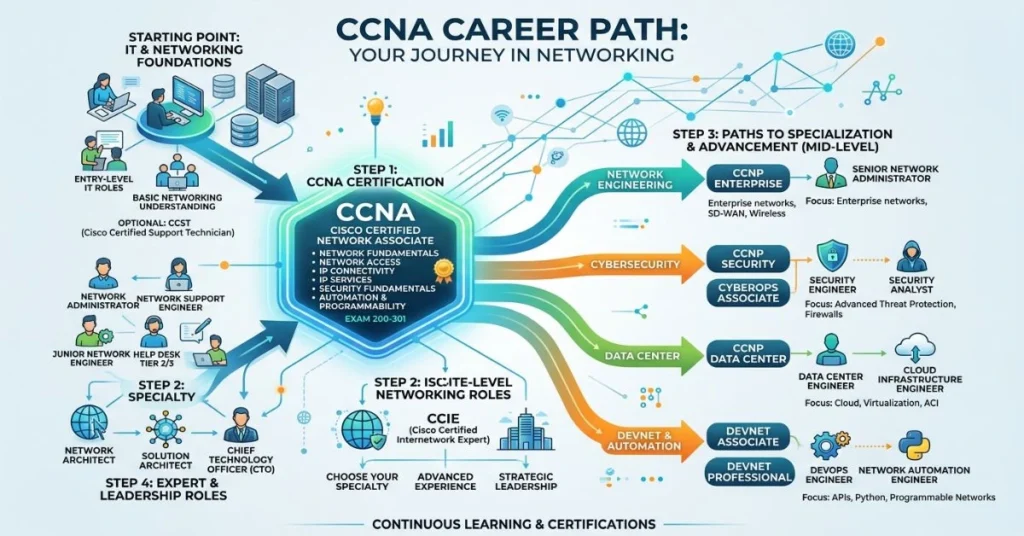
Understanding the full CCNA career path means looking at where you start, where CCNA sits, and where you can go once you have it.
Step 1 — Build Your Foundations
Before studying for the CCNA, spend time learning networking basics. Understand IP addressing, subnetting, the OSI model, and how routers and switches communicate. Free resources from Cisco’s own NetAcad platform and tools like Cisco Packet Tracer (Cisco’s network simulator) are excellent starting points.
This foundation phase typically takes 2–4 months depending on your starting point and the time you can commit each week.
Step 2 — Prepare and Pass the CCNA Exam
Once your foundations are solid, structured CCNA study typically takes 3–6 months. You’ll cover:
| Exam Domain | Approximate Weight |
|---|---|
| Network Fundamentals | 20% |
| Network Access | 20% |
| IP Connectivity | 25% |
| IP Services | 10% |
| Security Fundamentals | 15% |
| Automation & Programmability | 10% |
Study through a registered training of CCNA Certification organisation or structured course to get hands-on lab practice alongside theory. Reading alone rarely prepares you well enough for the practical elements of the exam.
The CCNA exam costs in Australia around AUD $450–$500 and is delivered through Pearson VUE testing centres across Australia, including locations in Melbourne, Sydney, Brisbane, and Perth.
Step 3 — Land Your First Networking Role
With a CCNA in hand, you’re competitive for junior and mid-level networking positions. Common first roles include:
- Network Administrator — managing switches, routers, and firewalls for an organisation
- Network Support Engineer — troubleshooting connectivity issues, often in helpdesk or NOC environments
- Junior Systems Engineer — working across both networking and server infrastructure
- IT Infrastructure Technician — broad role covering networks, hardware, and end-user support
Step 4 — Gain Experience and Specialise
Experience is what turns a certification into a career. After 1–2 years in a networking role, you’ll start to identify which area you enjoy most — security, wireless, cloud, or data centre. This is when you start thinking about Cisco’s specialist tracks.
The CCNA acts as a gateway to Cisco’s professional-level certifications. At the CCNP level, you specialise:
| Specialisation | CCNP Track | Suited To |
|---|---|---|
| Enterprise networking | CCNP Enterprise | Network engineers in corporate environments |
| Security | CCNP Security | Security analysts, firewall engineers |
| Data Centre | CCNP Data Center | Cloud and infrastructure engineers |
| Service Provider | CCNP Service Provider | Telco and ISP roles |
| Collaboration | CCNP Collaboration | Unified communications engineers |
Each CCNP track sits comfortably above the CCNA on the Cisco certification ladder and can push your salary into the $100,000–$130,000+ range.
CCNA Career Path in Australia: The Local Picture
CCNA Melbourne in particular has a growing demand for network professionals, especially in managed service providers (MSPs), which hire CCNA-certified technicians to manage infrastructure for multiple clients at once. MSP roles are excellent for new CCNA holders because of the variety of environments you work in early in your career.
How Long Does the Full CCNA Path Take?
Realistically, expect the following timelines:
- Foundations to CCNA exam ready: 3–6 months
- Job placement after certification: 1–4 months (varies by location and market)
- CCNA to CCNP ready: 2–4 years of work experience plus study
So from starting with zero background to holding a mid-level networking role, most people achieve this in under 2 years with consistent effort. That’s a fast career transition compared to a 3–4 year university degree.
Common Mistakes to Avoid
A few things trip people up on the CCNA path:
Relying only on theory. The exam tests practical skills. Use Cisco Packet Tracer or rent access to real lab equipment. Hands-on practice is not optional.
Skipping subnetting practice. Subnetting questions appear throughout the exam and in real jobs. Spend extra time here until it becomes second nature.
Not renewing the certification. The CCNA is valid for 3 years. After that, you need to recertify by passing the CCNA again or a higher-level exam. Set a reminder and plan ahead.
Isolating study. Networking communities on Reddit (r/ccna), Discord servers, and local study groups can help you stay motivated and get quick answers to questions. Use them.
Start Your CCNA Career Path Today
If you’re ready to take the first step, the team at CCNA Certification Australia can help you find the right course and study pathway based on your background and goals.
Located at Suite 3, 53 Dryburgh Street, West Melbourne VIC 3003, we work with students across Australia to make the CCNA achievable — whether you’re studying full-time, part-time, or fitting it around a full-time job.
Ready to get started? Explore our CCNA courses and enrolment and speak with a trainer who can map out your personal study plan.
Frequently Asked Questions
1: Is CCNA Worth It in Australia in 2026?
Answer: Yes, the CCNA is absolutely worth it in Australia. It is one of the most recognised networking certifications employers actually look for when hiring, and the job market here backs that up.
2: What Salary Can I Expect with a CCNA in Australia?
Answer: With a CCNA certification in Australia Jobs, entry-level networking roles typically start between AUD $65,000 and $85,000 per year. With 3–5 years of experience behind you, that figure moves into the $90,000–$130,000 range for mid-level network engineers and senior administrators.
3: How Long Does It Take to Get CCNA Certified?
Answer: Most people get CCNA-ready within 3 to 6 months of focused study, depending on how much time they commit each week and what IT knowledge they’re starting with.
4: What Jobs Can You Get with a CCNA in Australia?
Answer: A CCNA opens the door to several solid entry and mid-level networking roles across Australia.
- Network Administrator — managing switches, routers, and firewalls within an organisation’s internal infrastructure
- Network Support Engineer — resolving connectivity issues in helpdesk or network operations centre (NOC) environments
- Junior Network Engineer — working on network design, deployment, and troubleshooting projects
- IT Infrastructure Technician — a broader role covering networks, hardware, and system support
- Field Network Engineer — on-site installation and maintenance of network equipment, common in MSP roles
5: Is CCNA Harder Than CompTIA Network+?
Answer: Yes, the CCNA is generally considered harder than CompTIA Network+. The Network+ is vendor-neutral, meaning it covers broad networking concepts without tying you to specific equipment or software.
6: What Is the Next Step After CCNA?
Answer: After passing your CCNA, the natural next step is to gain 1–2 years of real-world networking experience before pursuing the CCNP Certification. The CCNP is where you specialise — you pick a track based on where your career is heading.
The most popular CCNP tracks for Australian professionals are:
- CCNP Enterprise — for network engineers working in corporate infrastructure environments
- CCNP Security — for those moving into firewall management, threat response, and security engineering
- CCNP Data Center — for engineers working with cloud platforms and data centre infrastructure