





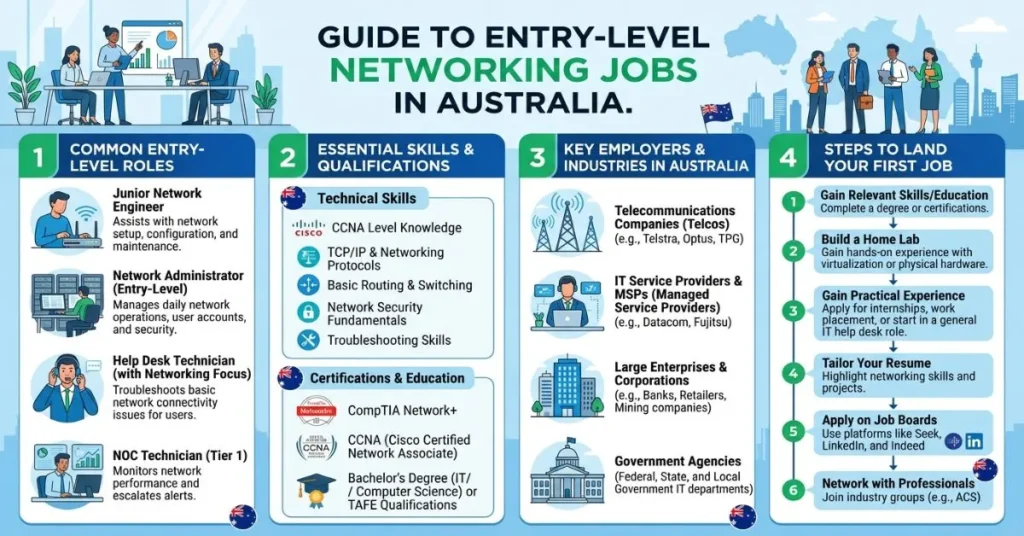
Entry level networking jobs are the starting roles that help you break into the IT networking field. These jobs usually include positions like IT support, junior network engineer, or help desk technician, where you learn real-world skills while supporting network systems.
If you’re in Australia and looking to build a career in networking, this guide shows what to expect, skills you need, salaries, and how to get your first role without confusion.
Why networking jobs are in demand
Networking remains a core part of Australia’s digital growth. Businesses rely on secure and stable networks to operate daily systems, cloud tools, and remote work setups.
Australia’s IT industry continues to expand due to cloud adoption, cybersecurity needs, and infrastructure upgrades.
Job listings also show consistent demand, with hundreds of roles across cities like Melbourne, Sydney, and Perth.
That demand means entry-level roles are often available for beginners who have the right skills and certifications.
book your CCNA Certification seat.
Common entry level networking jobs
Most beginners don’t become network engineers straight away. You usually start with support roles and move up.
Here are common entry-level roles in Australia:
| Job Role | What You Do | Typical Salary (AUD) |
|---|---|---|
| IT Support Technician | Fix network and system issues | $55,000 – $70,000 |
| Help Desk Analyst | Provide user support and troubleshooting | $60,000 – $75,000 |
| Junior Network Engineer | Assist with network setup and monitoring | $60,000 – $75,000 |
| Network Support Engineer | Maintain LAN/WAN systems | $65,000 – $80,000 |
Entry level engineers in Australia often start between $60,000 and $75,000 annually.
These roles give you hands-on exposure, which is critical for career growth.
What you do in these roles
Your daily tasks focus on learning and supporting existing systems.
Typical responsibilities include:
- Monitoring network performance and alerts
- Fixing connectivity issues
- Configuring routers and switches
- Handling support tickets
- Assisting senior engineers
- Maintaining documentation
You are not expected to know everything at the start. Your main job is to understand how networks run and fix basic issues.
Entry-level engineers usually work under supervision while building confidence. Skills you need to get hired
You don’t need advanced knowledge to start, but you do need solid fundamentals.
Technical skills
- IP addressing and subnetting
- Routing and switching basics
- Network protocols like DNS and DHCP
- Firewall and network security basics
- Troubleshooting skills
Networking roles also require understanding how data flows across systems and networks.
Soft skills
- Clear communication
- Problem-solving
- Teamwork
- Time management
Employers in Australia value people who can explain technical issues in simple terms.
Why CCNA matters for entry roles
If you want to increase your chances of landing entry level networking jobs, getting certified is a smart move.
The Cisco Certified Network Associate (CCNA) is one of the most recognised certifications globally. It proves that you understand network fundamentals and can work with real systems.
In Australia, many employers list CCNA as a preferred or required qualification for junior roles.
What CCNA teaches you
- Network fundamentals
- Routing and switching
- Security basics
- Network automation concepts
It gives you practical knowledge that directly matches job requirements.
If you are serious about starting a networking career, explore your pathway through this guide on
entry level networking jobs
How to get your first networking job
You do not need a university degree to start. Many professionals in Australia begin through training and certifications.
Step-by-step path
- Learn networking basics
Understand IP, devices, and how networks work - Get certified
Start with CCNA Certification for strong credibility - Build hands-on experience
Use lab tools like Packet Tracer - Apply for entry roles
Focus on help desk or junior networking roles - Keep learning on the job
Grow into advanced roles over time
This structured path helps you enter the industry faster.
Where to find networking jobs in Australia
Most entry-level networking jobs are listed on job platforms and IT recruitment agencies.
Common places include:
- SEEK Australia
- LinkedIn Jobs
- Company career pages
- IT recruitment agencies
CCNA Melbourne, Sydney, and Brisbane have the highest number of opportunities.
Career growth after entry level roles
Networking offers a clear progression path, which is great if you want long-term stability.
Career levels
| Level | Role | Salary Range |
|---|---|---|
| Entry | Support / Junior Engineer | $60K – $75K |
| Mid | Network Engineer | $80K – $110K |
| Senior | Senior Engineer / Specialist | $110K – $140K+ |
As you gain experience, your salary and responsibilities increase significantly.
You can also specialise in areas like:
- Network security
- Cloud networking
- Wireless networking
Why networking is a smart career choice
Networking is not going away. It’s becoming more important with cloud, remote work, and cybersecurity.
Key reasons to choose networking:
- Strong job demand in Australia
- High salary growth over time
- Opportunities to specialise
- Global career potential
Technology may change, but networks remain the backbone of IT systems.
Training options in Melbourne
If you prefer in-person or guided learning, choosing a local training provider helps.
At CCNA Certification Australia, you can get hands-on training with real lab environments and structured guidance.
You can visit:
Suite 3, 53 Dryburgh Street, West Melbourne VIC 3003
This type of training helps you move faster compared to self-study.
Common mistakes beginners make
Avoid these if you want to land your first role faster:
- Skipping fundamentals
- Not practising hands-on labs
- Applying without certifications
- Ignoring soft skills
- Expecting senior roles too early
Focus on learning step by step and building real skills.
Start your networking career today
If you’re ready to move into IT, now is the right time to start.
Get the right training, build your skills, and begin applying for entry level networking jobs with confidence.
Explore your learning options at ccna certification
Or visit in person at West Melbourne to speak with a trainer.