

The short answer on the CCNA passing score is this: Cisco does not publish a fixed public pass mark for the current CCNA exam. Instead, you get a pass or fail result and a breakdown of how you performed across the exam domains. For the current 200-301 CCNA v1.1 exam, Cisco lists a 120-minute test, a US$300 exam fee, and results that are typically available online within 48 hours.
That matters because many learners still search for a single number, then build their whole plan around it. That is not the best way to prepare. A better approach is to understand how Cisco scores the exam, which topics carry more weight, and how to study in a way that gives you a safer margin on exam day.
If you are in Australia and preparing around work, TAFE, uni, or a career switch, this guide gives you the straight answer without the noise. It also helps you avoid the common mistake of chasing rumours instead of building the skills Cisco actually tests.
What is the CCNA passing score?
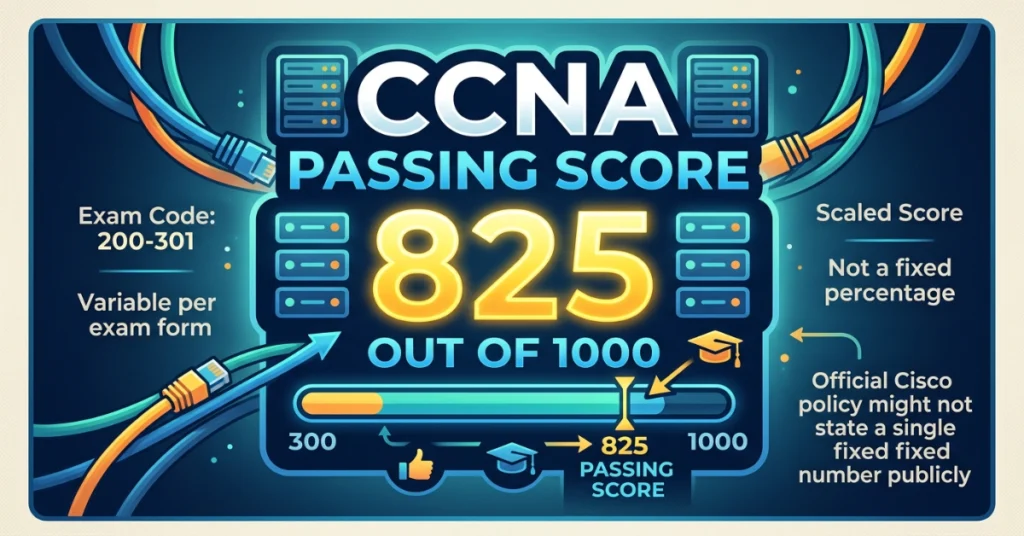
Cisco does not currently publish an exact CCNA passing score for the 200-301 exam. Your score report shows whether you passed or failed, along with section performance details, rather than a public scaled score that everyone can use as a target.
So if you are looking for a hard number like “825 out of 1000,” treat that as internet chatter, not official guidance.
This means smart question is not “What number do I need?” It is “What level of skill do I need across the full blueprint?”
Why Cisco avoids a fixed score
Cisco updates exams over time and uses different forms of the test. Because of that, the exact passing threshold can change. Cisco network focuses your result on what matters most after the exam: whether you passed and where your weak spots sit.
This is actually useful. If you fail, the domain breakdown tells you where to recover marks next time. If you pass, it still shows where your understanding needs work before you move into a job role or a higher certification.
For Australian candidates, that is practical. Many learners here juggle study with full-time work, shift work, or family commitments. You do not need mystery numbers. You need a study plan that matches the exam blueprint.
How the current CCNA exam works
The current exam is 200-301 CCNA v1.1. Cisco lists it as a 120-minute certification exam that covers six domains. Cisco also says pass or fail results will typically available online in 48 hours.
You can sit the exam at a Pearson VUE test centre or take eligible written Cisco exams online through OnVUE remote proctoring. That gives Australian learners more flexibility, especially if travel to a testing centre is awkward.
check belown current domain weighting published by Cisco:
| CCNA domain | Weight |
|---|---|
| Network Fundamentals | 20% |
| Network Access | 20% |
| IP Connectivity | 25% |
| IP Services | 10% |
| Security Fundamentals | 15% |
| Automation and Programmability | 10% |
One thing stands out straight away. IP Connectivity carries the biggest weighting at 25%. If your routing basics are weak, you feel it fast.
What your score report really means
After the exam, your report does not give you a simple public number to compare with someone else. It tells you if you passed or failed and shows your section performance. Cisco says this change is deliberate, so candidates focus on domain-level performance instead of one composite number.
That means you should read your report like a study map. A low result in Network Fundamentals can hurt a lot because it touches subnetting, IPv4, IPv6, wireless basics, switching concepts, and general troubleshooting.
The takeaway is simple. You do not need to obsess over an unofficial passing score. You need to lift the domains that carry the most marks and the topics that appear across multiple sections.
Best study focus by exam weight
If you want a realistic path to passing, match your study hours to the blueprint. Cisco already tells you what counts most, so use that instead of guessing.
A practical split looks like this:
| Study priority | Why it matters |
|---|---|
| IP Connectivity first | Largest weighting and often the hardest domain for new learners. |
| Network Fundamentals next | It supports subnetting, addressing, switching, wireless, and troubleshooting. |
| Network Access next | VLANs, trunks, STP, EtherChannel, and WLAN topics show up often. |
| Security Fundamentals | Worth 15% and easy marks if you practise the basics properly. |
| IP Services and Automation | Smaller sections, but you still need clean coverage. |
Do not fall into the trap of only revising what feels comfortable. Plenty of learners spend too long on familiar commands and not enough time on routing logic, subnetting, and troubleshooting. That usually shows up in the result.
A smart pass strategy for Aussies
If you are studying in Melbourne, Sydney, Brisbane, Perth, or anywhere regional, the best pass strategy is consistency. The CCNA is broad. You will struggle if you cram only on weekends and never touch lab work midweek.
Use three study layers. First, learn the concept. Second, lab it until you can configure and verify it without notes. Third, test it under time pressure. That matters because the exam mixes knowledge with applied thinking. Cisco openly lists performance-based questions as part of the format.
A strong weekly routine looks like this:
- 2 to 3 theory sessions for the blueprint topics
- 2 lab sessions for routing, switching, NAT, ACLs, and device access
- onee review session for weak areas and timed quiz
That routine is simple enough to keep going even if you work full time.
Book your CCNA Certification today
Where many candidates lose marks
Most failures are not about one “trick” question. They come from ordinary gaps that stack up across the exam.
The common problem areas are:
- weak subnetting speed
- poor route selection logic
- shaky OSPF basics
- confusion around VLANs and trunking
- ACL mistakes
- surface-level automation knowledge
These weak spots line up closely with Cisco’s published blueprint, especially in Network Fundamentals, Network Access, IP Connectivity, and Security Fundamentals.
If you want to lift your odds of passing, get the basics clean first. Fast subnetting, clean static routing, single-area OSPF, VLAN behaviour, NAT, DHCP, SSH, and ACL logic all need to feel normal, not stressful.
Exam day without the guesswork
The exam itself is available through Pearson VUE, either at an authorised test centre or online through OnVUE for eligible written exams. If you sit online, make sure your room setup, ID, webcam, and system checks are done early.
For test centre candidates in Australia, plan your route and arrive settled. For online candidates, remove distractions and give yourself a calm buffer before the start time. The exam is hard enough without avoidable stress.
Also remember this: your result may be shown quickly, but official reporting can take a bit longer. Cisco says results are typically available online within 48 hours, while Cisco support guidance also notes final exam result checks can take up to 72 hours through Pearson VUE authentication.
Should you chase a score or mastery?
Mastery wins. If you study only to scrape over a rumoured cut score, you leave yourself no room for a hard paper, nerves, or one bad section. The better target is to be genuinely comfortable in every domain and stronger in the high-weight areas.
That matters even more once you start applying for network support, NOC, help desk, or junior network engineer roles in Australia. Employers do not care that you guessed your way past a mark. They care whether you can troubleshoot, explain your logic, and work cleanly on real devices.
If your goal is a first-time pass, prepare to beat the blueprint, not the rumour mill.
How to know you are ready
You are close to ready when you can:
- subnet quickly without a calculator
- explain route choice with confidence
- configure VLANs, trunks, static routes, OSPF, NAT, SSH, and ACLs cleanly
- read a small topology and spot likely faults
- move through practice questions without panic
You should also be scoring consistently in your own revision, not bouncing between lucky highs and bad lows. Steady performance is a better sign than one great practice result.
If you still freeze on routing decisions or basic switching behaviour, keep studying. A delay of two weeks is cheaper than a retake.
Get local CCNA support
If you want local help instead of random forum advice, visit ccnacertification.com.au and build a proper plan around the current exam blueprint. A focused study path saves time, cuts confusion, and gives you a better shot at passing on the first go.
If you prefer face-to-face guidance in Melbourne, you can also connect with the team at Suite 3, 53 Dryburgh Street, West Melbourne VIC 3003. That is a practical option if you want structure, accountability, and local support while you prepare.
Final word
A fixed public CCNA passing score is not the thing to chase. Cisco does not publish one for the current exam. What matters is your pass or fail result, your performance by domain, and how well your study plan matches the blueprint.
If you want to pass, focus on what Cisco actually tests. Build your routing, switching, security, and troubleshooting skills. Put extra time into IP Connectivity, keep your fundamentals sharp, and treat the exam like a practical networking check, not a guessing game. That is the approach that gives Australian candidates the best chance of getting through cleanly.