




The CCNA Exam Syllabus covers the core networking topics you need to understand before working in IT networking roles. It focuses on network fundamentals, IP services, security basics, automation, and routing and switching. If you are preparing in Australia, this syllabus gives you a clear path to build job-ready skills.
If you want a structured path that matches industry expectations, you can explore the full learning roadmap through this
CCNA Exam Syllabus
What is the CCNA exam
The Cisco Certified Network Associate (CCNA) exam validates your ability to install, configure, and troubleshoot networks. It is an entry-level certification but has strong industry recognition across Australia.
Most employers use CCNA as a benchmark when hiring junior network engineers or IT support staff. It shows you understand how networks operate in real environments.
The current exam code is 200-301, which combines multiple networking topics into one exam.
Book you CCNA Certification
Why the syllabus matters
The syllabus is not just theory. It directly connects to what you do on the job.
When you follow the CCNA Certification, you learn:
- How devices communicate
- How to secure a network
- How to fix network issues
- How to work with routers and switches
This matches real tasks in entry-level networking roles in Australia.
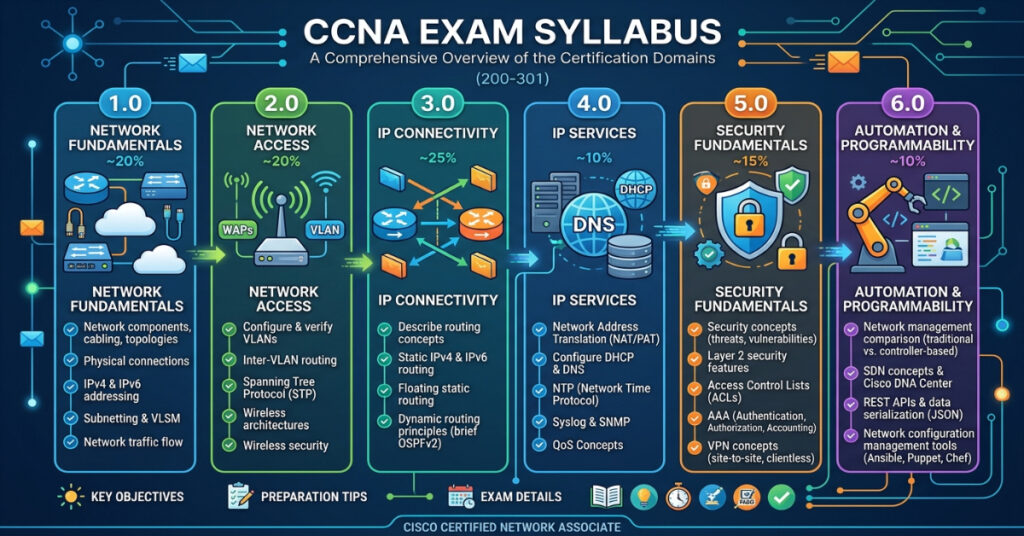
Full CCNA syllabus breakdown
The CCNA syllabus is divided into various domains. Each section focuses on a specific part of networking.
Core topics overview
| Domain | Weight | Focus Area |
|---|---|---|
| Network Fundamentals | 20% | Basics of networking |
| Network Access | 20% | Switching and LAN |
| IP Connectivity | 25% | Routing technologies |
| IP Services | 10% | DHCP, DNS, NAT |
| Security Fundamentals | 15% | Network protection |
| Automation & Programmability | 10% | Modern networking tools |
This structure helps you prepare step by step without confusion.
Network fundamentals basics
This section builds your foundation. You learn how networks operate and how devices communicate.
You focus on:
- OSI and TCP/IP models
- IPv4 and IPv6 addressing
- Subnetting techniques
- Network devices such as routers and switches
Understanding these network models is critical before moving to advanced topics.
Most beginners struggle here, so take time to practise addressing and subnetting.
Network access concepts
This concept explains how devices connect within a local network.
You learn how switches handle traffic and how VLANs work.
Key topics include:
- Ethernet switching
- MAC address tables
- VLAN configuration
- Wireless basics
This section helps you understand how office networks function.
In Australian workplaces, VLANs are widely used to separate departments and improve security.
IP connectivity essentials
This is one of the most important parts of the CCNA syllabus.
You learn how data moves between networks using routers.
Topics include:
- Static routing
- Dynamic routing protocols (OSPF)
- Route selection and forwarding
- Troubleshooting routing issues
IP Routing is a key skill for network engineers. Many entry-level roles expect basic knowledge here.
IP services explained
IP services are the background systems that keep networks running smoothly.
You study:
- DHCP (automatic IP assignment)
- DNS (name resolution)
- NAT (address translation)
- NTP (time synchronisation)
These services are parts of daily network operations.
You may not configure them every day, but you need to understand how they work.
Security fundamentals
Network security protects systems from threats and unauthorised access.
This section introduces:
- Firewalls and ACLs
- Secure network design
- Basic device security
- Threat awareness
Security knowledge is essential in Australia due to increasing cyber risks.
Even entry-level roles require awareness of safe network practices.
Study approach for Australians
If you are studying in Australia, your approach should be practical and structured.
Recommended learning steps
Start with foundational topics like IP addressing and network models.
Move to switching and routing once basics are clear.
Then focus on lab practice using simulation tools.
Finally, revise with mock exams and real scenarios.
Consistency is more important than speed.
Join CCNA Certification Melbourne
How long preparation takes
The preparation depends on your starting level.
- Beginner: 3 to 6 months
- Basic IT experience: 2 to 4 months
Daily practice and lab work can speed up your progress.
Avoid rushing. Understanding concepts deeply is more useful than memorising answers.
Common mistakes to avoid
Many students struggle because of avoidable mistakes.
Here are key ones:
- Skipping subnetting practice
- Ignoring lab work
- Relying only on theory
- Not revising regularly
- Avoiding troubleshooting scenarios
Focus on hands-on learning to build confidence.
Career outcomes after CCNA
Once you complete the CCNA modules syllabus and pass the exam, you can apply for entry roles.
Job roles include:
- Network support technician
- Help desk analyst
- Junior network engineer
- IT support specialist
These roles are widely available in Melbourne and across Australia.
CCNA helps you stand out when applying for these positions.
Local training in Melbourne
If you want guided learning, in-person training can help.
At CCNA Certification Australia, you can access structured classes and hands-on labs.
📍 Suite 3, 53 Dryburgh Street, West Melbourne VIC 3003
This setup helps you understand complex topics faster and with confidence.
Start learning the CCNA Exam with a structured approach and real-world practice.
Get expert guidance today
If you need help choosing the right study plan, speak to a local expert.
Visit or enquire at:
Suite 3, 53 Dryburgh Street, West Melbourne VIC 3003
Get clear advice and take the first step towards a networking career.
Visit ccna certification to explore training options and begin your preparation.
Final takeaway
The CCNA Exam Syllabus gives you everything you need to start a networking career. It covers real-world skills that match job expectations in Australia.
Focus on understanding, practise consistently, and build confidence step by step. That’s how you turn knowledge into a real IT career.