




CCNA certification is built around one skill that quietly sits underneath almost every IT job: understanding how networks really work, and being able to fix them when they break. Whether you want to be a help desk analyst, a cloud engineer, a cybersecurity specialist or a network administrator, sooner or later your work depends on it. Yet very few people master it properly.
Every application, cloud service, video call and security tool travels across a network. When that network slows down, drops out or is misconfigured, everything built on top of it fails with it. The professionals who can calmly trace a fault from a user’s laptop to a switch, a router and a firewall are the ones teams rely on, promote and pay well. In this guide you will learn what that skill is, why so few people master it, and how CCNA certification gives you a proven, employer-recognised path to build it. For the official exam blueprint, you can also review the Cisco CCNA certification page.
The Skill Every IT Career Depends On: Networking Fundamentals
The skill is not a single product or programming language. It is a combination of networking fundamentals and structured troubleshooting: knowing how IP addressing, subnetting, routing, switching and network services fit together, and using that knowledge to find the cause of a problem quickly instead of guessing. Trends come and go, but the network underneath them stays. That is why this skill outlasts every new tool.
Look at how many IT roles lean on it every day:
- Help desk and support: most “the internet is down” tickets are really DNS, DHCP, cabling or VLAN problems.
- Cloud engineering: virtual networks, subnets, routing tables and security groups all use the same concepts taught in networking.
- Cybersecurity: you cannot defend traffic you do not understand. Firewalls, access control lists and segmentation are networking topics first.
- DevOps and automation: pipelines, containers and APIs depend on reliable connectivity and name resolution.
- Systems administration: servers are only useful when users and other systems can reach them.
Why So Few People Master Networking
Networking looks simple from the outside because it usually “just works”. The difficulty only appears when something fails and you have to reason about invisible traffic moving through several devices. Three habits keep most people from mastering it.
They skip the fundamentals
Many learners jump straight to cloud platforms or security tools without understanding how a packet moves from one device to another. Without that foundation, every new technology feels like a pile of disconnected settings to memorise.
They learn theory without hands-on practice
Reading about OSPF or VLANs is very different from configuring them, breaking them and repairing them. Real confidence only arrives after you have typed the commands, seen the error messages and fixed the fault yourself on real equipment or a simulator.
They troubleshoot by guesswork
Untrained troubleshooting looks like rebooting things and hoping. Skilled troubleshooting is a method: define the problem, check the physical and link layers, verify addressing and routing, test services, then confirm the fix. Most people never get formally taught that method, which is exactly the gap the CCNA closes.
What CCNA Certification Teaches You
CCNA certification validates the knowledge needed to install, configure, operate and troubleshoot small to medium-sized enterprise networks. Today there is a single CCNA exam, 200-301, which replaced the older CCNA tracks (Routing and Switching, Security, Wireless, Cloud and others). It covers the areas below.
- Network fundamentals: network components, topologies, TCP and UDP, IPv4 and IPv6 addressing and subnetting.
- Network access: VLANs, trunking, EtherChannel, spanning tree and wireless architectures.
- IP connectivity: static routing, OSPF and how routers choose the best path.
- IP services: NAT, DHCP, DNS, NTP, SNMP and quality of service.
- Security fundamentals: access control lists, port security, VPN concepts and device hardening.
- Automation and programmability: controller-based networking, REST APIs and configuration management tools.
Because the syllabus follows the way real networks are built, the CCNA works as a complete map of the skill this article is about. It also lines up with the pathways recognised by Australian IT bodies such as the Australian Computer Society and by employers across the country.
How CCNA Certification Builds a Troubleshooting Mindset
The biggest benefit of the CCNA is not memorised commands. It is a repeatable way of thinking. Candidates learn to work through a fault in a logical order rather than jumping between random fixes:
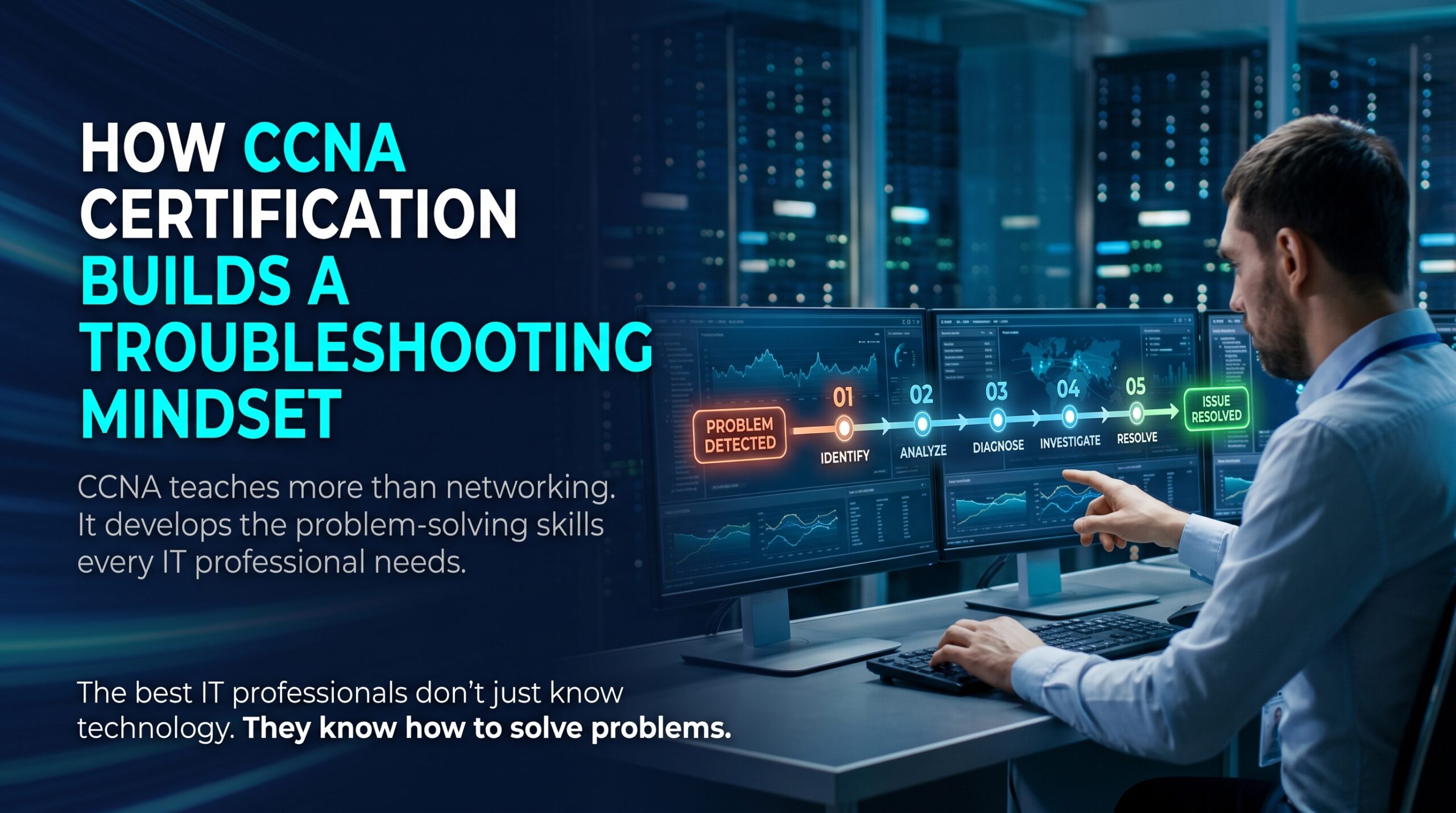
- Identify the symptom and who is affected.
- Check the physical connection, interface status and link lights.
- Verify IP addressing, subnet masks and default gateways.
- Confirm switching, VLAN and routing information.
- Test higher-level services such as DNS and DHCP.
- Apply one change at a time and document the result.
Once this process becomes habit, you stop fearing outages. You become the person who stays calm, finds the cause and explains it clearly, which is the quality managers remember when promotions come up.
Career Paths and Job Opportunities with CCNA Certification
Employers use the CCNA as quick proof that a candidate can handle real networking work. It opens doors to roles such as network administrator, network engineer, systems engineer, IT support analyst, security analyst and IT consultant. It is also the standard first step toward CCNP and, for ambitious engineers, CCIE. You can browse live networking roles on SEEK to see how often CCNA appears in job requirements.
The certification also helps people already working in IT. If you have drifted into support, systems or cloud work without a formal networking foundation, the CCNA fills the gaps and gives you the vocabulary and confidence to move into engineering roles.
CCNA Certification Training in Sydney, Melbourne, Brisbane, Adelaide, Perth and Canberra
You do not need to relocate to get quality instruction. Instructor-led CCNA training is available in Melbourne, Sydney, Brisbane, Adelaide, Perth and Canberra, as well as in-house for company teams and live virtually for people anywhere in Australia. Training with an instructor means you can ask questions, practise on Cisco devices and simulators, and get feedback while you learn.
- CCNA course in Melbourne and Sydney: the largest IT job markets, ideal if you want a classroom environment close to employers. Explore the CCNA course in Melbourne and the CCNA course in Sydney.
- CCNA course in Brisbane and Adelaide: convenient for growing tech and defence-related sectors. See the CCNA training in Brisbane and CCNA training in Adelaide.
- CCNA course in Perth and Canberra: strong demand from mining, government and enterprise networks. View the CCNA course in Perth and CCNA course in Canberra.
- Live virtual and in-house: attend from home or bring a trainer to your office for a whole team.
CCNA Certification Course Options, Pricing and Schedule
The CCNA certification course is designed for busy people, with flexible timing and the exam included. Current options include:
- Full-time (weekdays): 5 days, Monday to Friday, 9:30 am to 5 pm. Price from $2,199.
- Part-time (weeknights): 5 weeks, Mondays and Tuesdays, 6 pm to 9 pm. Price from $1,649.
- Part-time (weekends): 5 weeks, Saturdays, 10 am to 5 pm. Price from $1,649.
Each option includes the CCNA 200-301 exam voucher (valued at $432), the official Cert Guide Library, practice questions and a certificate of course completion. Full-time participants also receive mock tests, and the exam can be attempted at an authorised test centre. The training team has prepared more than 1,500 Cisco professionals and is led by a CCIE-certified instructor with over 15 years of experience. Check the CCNA certification course page for the latest dates and prices.
How to Prepare for CCNA Certification: A Simple Study Plan
- Refresh basic computer and networking concepts (no formal prerequisites are required).
- Book an instructor-led course so you learn in the correct order.
- Practise every topic in a lab or simulator, especially subnetting and routing.
- Use practice questions and mock tests to find weak areas.
- Sit the exam while the material is fresh, then plan your next step toward CCNP.
Learn more about community support and study resources on the Cisco Learning Network.
Frequently Asked Questions About CCNA Certification
Is CCNA certification worth it?
Yes. It is one of the most recognised entry-to-mid level IT credentials in the job market, and it proves hands-on networking ability that employers actually test for in interviews.
Do I need experience before starting?
No formal prerequisites exist, but basic computer knowledge and a familiarity with networking concepts will help you move faster.
How long does CCNA training take?
The full-time course runs five days, while the part-time options run over five weeks on weeknights or Saturdays.
Which CCNA exam is available now?
Only the CCNA 200-301 exam is current. All older CCNA tracks were retired in February 2020.
Can I study CCNA online in Australia?
Yes. Live virtual, instructor-led classes let you train from any Australian city, with the same material as classroom students.
Master the Skill, Build the Career
Every IT career depends on networking, and the people who truly master it stand out in any team. CCNA certification gives you the fundamentals, the hands-on practice and the troubleshooting mindset in one structured program. Ready to start? Book your CCNA certification course today and take the first step toward a career that is built on solid foundations.