




If you’ve got an interview coming up, these CCNA interview questions will help you walk in prepared. Whether you’re applying for your first Network Support Technician role or stepping up to Junior Network Engineer, Australian employers tend to test the same core areas: OSI model fundamentals, IP addressing and subnetting, routing and switching, security basics, and how you think through real troubleshooting scenarios.
This guide covers 40+ CCNA interview questions and answers organised by topic, plus practical tips on how Australian hiring managers evaluate candidates, so you can revise efficiently instead of guessing what might come up.
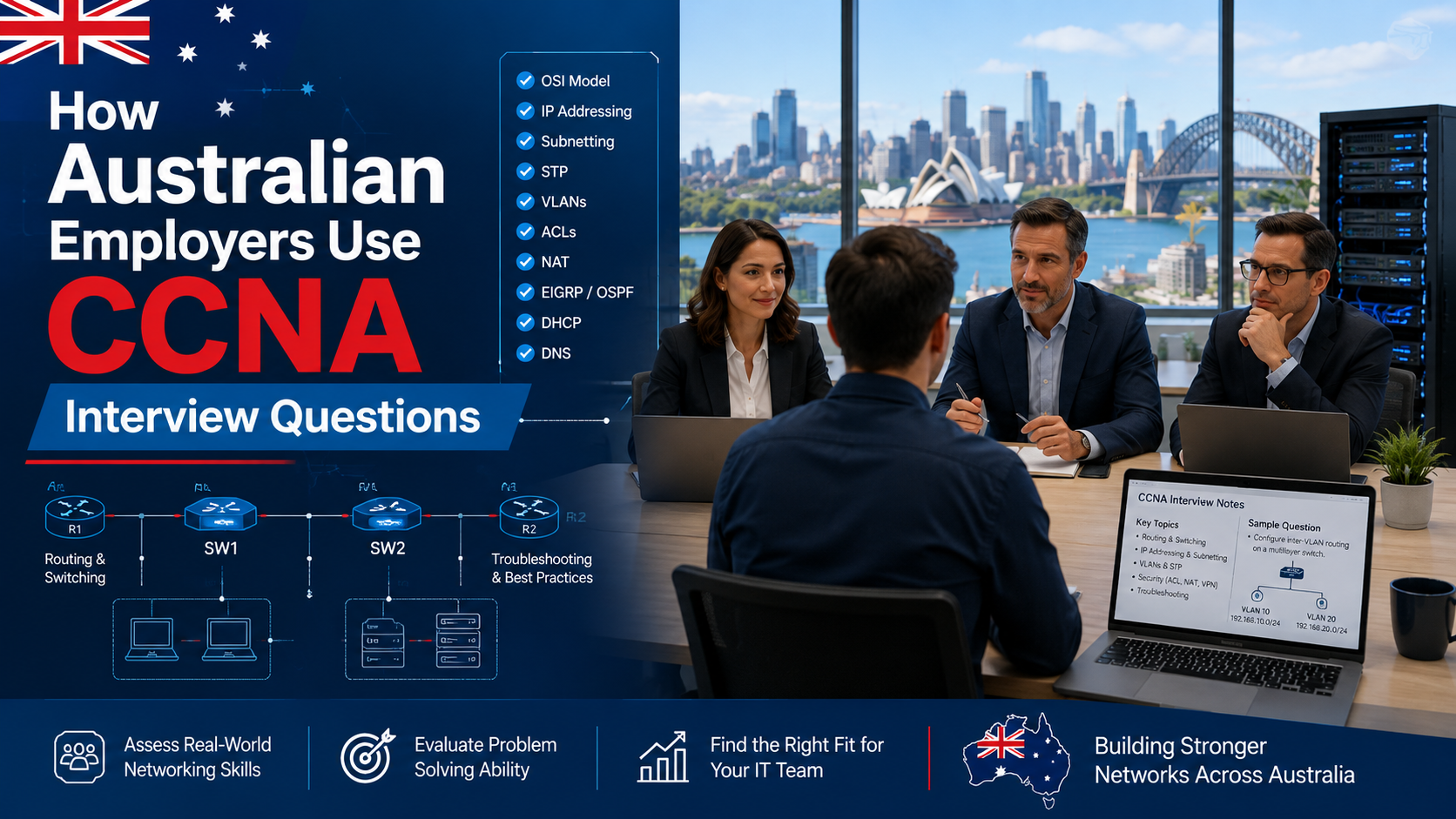
How Australian Employers Use CCNA Interview Questions
Most networking interviews in Australia mix three question types: knowledge checks (define a term or protocol), applied questions (how would you configure X), and scenario-based troubleshooting (a network is down walk me through your approach). Interviewers are usually less interested in memorised definitions and more interested in whether you can explain your reasoning clearly, which matters just as much as getting the technical answer right.
Basic CCNA Interview Questions
Q: What is the OSI model and why does it matter?
A: The OSI model is a seven-layer framework (Physical, Data Link, Network, Transport, Session, Presentation, Application) that standardises how network communication works. It matters because it gives you a shared language for isolating problems for example, knowing a fault is at Layer 2 versus Layer 3 changes your entire troubleshooting approach.
Q: What’s the difference between a router and a switch?
A: A switch operates mainly at Layer 2, forwarding frames within a local network based on MAC addresses. A router operates at Layer 3, forwarding packets between different networks based on IP addresses, and can make path decisions using routing tables.
Q: What is the difference between TCP and UDP?
A: TCP is connection-oriented, provides reliable delivery, and handles retransmission of lost packets used for things like web browsing and file transfers. UDP is connectionless and faster but doesn’t guarantee delivery, so it’s used for latency-sensitive traffic like VoIP and video streaming.
Q: What is a VLAN and why would you use one?
A: A VLAN (Virtual LAN) logically segments a physical network into separate broadcast domains without needing separate physical switches. It’s used to improve security, reduce broadcast traffic, and organise devices by department or function rather than physical location.
Q: What is the purpose of a default gateway?
A: A default gateway is the device usually a router that a host sends traffic to when the destination IP address is outside its own local subnet. Without it, a device can only communicate within its local network.
Subnetting and IP Addressing Questions
Q: How would you subnet a /24 network into four smaller subnets?
A: You’d borrow 2 bits from the host portion to create 4 subnets, changing the subnet mask from /24 to /26. This gives four subnets, each with 64 addresses (62 usable host addresses after the network and broadcast addresses).
Q: What’s the difference between a public and private IP address?
A: Private IP addresses (like the 10.0.0.0/8, 172.16.0.0/12 and 192.168.0.0/16 ranges) are used within internal networks and aren’t routable on the public internet. Public IP addresses are globally unique and routable, typically assigned by an ISP.
Q: What is NAT and why is it used?
A: NAT (Network Address Translation) translates private IP addresses to a public IP address so internal devices can access the internet while conserving public IPv4 addresses. It also adds a layer of security by hiding internal network structure from outside.
Q: How many usable hosts are in a /27 subnet?
A: A /27 subnet has 32 total addresses, minus the network and broadcast addresses, leaving 30 usable host addresses.
Routing and Switching Questions
Q: What’s the difference between static and dynamic routing?
A: Static routes are manually configured and don’t change unless an administrator updates them simple but not scalable. Dynamic routing protocols like OSPF automatically learn and adjust routes based on network changes, which suits larger or more complex networks.
Q: Explain how OSPF chooses the best path.
A: OSPF is a link-state protocol that calculates the shortest path using cost, which is typically based on interface bandwidth. It builds a complete map of the network topology and uses Dijkstra’s algorithm to determine the lowest-cost path to each destination.
Q: What is STP and what problem does it solve?
A: Spanning Tree Protocol (STP) prevents Layer 2 loops in networks with redundant switch links. Without it, redundant paths can cause broadcast storms and MAC address table instability; STP blocks redundant paths while keeping them available as backups.
Q: What’s the difference between a trunk port and an access port?
A: An access port carries traffic for a single VLAN and is typically used to connect end devices. A trunk port carries traffic for multiple VLANs simultaneously, usually using 802.1Q tagging, and is used to connect switches to each other or to routers.
Q: What is EtherChannel used for?
A: EtherChannel bundles multiple physical switch links into a single logical link, increasing available bandwidth and providing redundancy without triggering STP to block the extra links.
Network Security Questions
Q: What’s the difference between an ACL and a firewall?
A: An ACL (Access Control List) is a set of rules configured directly on a router or switch to permit or deny traffic based on criteria like source/destination IP and port. A firewall is typically a dedicated device or software with more advanced capabilities, such as stateful inspection and deep packet analysis, though ACLs can provide basic firewall-like filtering.
Q: What is port security and why would you enable it?
A: Port security restricts which devices can connect to a switch port, typically by limiting the number of allowed MAC addresses. It’s used to prevent unauthorised devices from connecting to the network and to mitigate MAC flooding attacks.
Q: What is the difference between authentication and authorization?
A: Authentication verifies who a user is, usually through credentials. Authorization determines what that authenticated user is allowed to access or do once verified. Both are required for secure network access control.
Scenario-Based CCNA Interview Questions
Q: A user can’t access the internet but can access local network resources. How do you troubleshoot it?
A: Start by checking the user’s IP configuration for a valid address, subnet mask and default gateway. Then confirm the default gateway is reachable, check DNS resolution, and verify whether other users on the same segment have the same issue — narrowing down whether it’s device-specific, switch-specific, or a wider routing/NAT problem upstream.
Q: Two switches are connected with redundant links and users report intermittent connectivity. What could be happening?
A: This is a classic sign of a Layer 2 loop, possibly caused by STP misconfiguration or a disabled STP instance. Check STP status on both switches, confirm root bridge election is correct, and look for MAC address table instability or broadcast storm indicators.
Q: A new VLAN was created but devices on it still can’t communicate with other VLANs. What would you check?
A: Confirm inter-VLAN routing is configured, either via a router-on-a-stick setup or a Layer 3 switch with SVIs. Check that the VLAN is allowed on the trunk link between switches and router, and confirm the new VLAN has a correctly configured gateway address.
Q: How would you approach diagnosing high latency on a WAN link?
A: Start with basic connectivity tests (ping, traceroute) to identify where delay is introduced. Check interface error counters and utilisation on both ends of the link, review QoS configuration if voice or video traffic is affected, and confirm there’s no bandwidth oversubscription during peak hours.
Behavioural and General Career Questions
Australian interviewers also ask behavioural questions to assess how you work in a team and handle pressure. Be ready to discuss a time you diagnosed a tricky network issue, how you keep your skills current, and why you’re pursuing a CCNA rather than (or alongside) other certifications.
- “Tell me about a time you had to troubleshoot something under time pressure.”
- “How do you stay current with networking technology and Cisco updates?”
- “Why are you pursuing CCNA specifically?”
- “Describe how you’d document a network change before implementing it.”
Tips for Acing Your CCNA Interview in Australia
- Practise explaining concepts out loud, not just recognising correct answers on a multiple-choice exam
- Use Cisco Packet Tracer to actually build the scenarios you’re likely to be asked about hands-on recall beats memorised theory
- Be honest about what you don’t know, then explain how you’d find out interviewers value structured troubleshooting over guessing
- Research the employer’s likely network environment (MSP, enterprise, government) and tailor examples accordingly
If you’re still building toward certification, our CCNA Training Course and CCNA Exam Preparation resources cover every topic in this guide with hands-on labs, while CCNA Exam Tips and CCNA Exam Questions help you revise before exam day.
Where CCNA-Certified Network Engineers Are in Demand Across Australia
CCNA-certified professionals are hired across every major Australian city. Managed service providers and enterprise IT teams in Sydney, Melbourne, Brisbane, Perth, Adelaide and Canberra regularly list CCNA as preferred or required for network support and engineering roles.
Frequently Asked Questions
How technical are CCNA interviews really?
It depends on the role level. Entry-level support roles often focus on fundamentals and communication skills, while network engineer roles go deeper into configuration and troubleshooting scenarios like the ones covered above.
Do I need to hold the CCNA certification before interviewing?
Not always — some employers hire candidates who are studying toward CCNA, especially for junior roles. However, holding the certification signals job-readiness and often gets your resume shortlisted faster.
What’s the best way to practise scenario-based questions?
Build the scenarios yourself in Cisco Packet Tracer or real lab hardware, then practise explaining your troubleshooting steps out loud as if you were talking an interviewer through your thinking.
Are these questions based on the current CCNA 200-301 exam?
Yes, the topics align with the current CCNA 200-301 syllabus covering network fundamentals, IP connectivity, security fundamentals and automation see Cisco’s official CCNA certification page for the full exam blueprint.
Final Thoughts
Walking into an interview with these CCNA interview questions rehearsed not memorised word-for-word, but genuinely understood puts you ahead of most candidates. Employers can tell the difference between someone reciting definitions and someone who can reason through a real network problem. Contact us if you’d like mock interview practice or hands-on lab time before your next application.