




The network knowledge risk is one of the quietest threats inside Australian businesses today. It looks like a success story: one talented person keeps the Wi-Fi humming, the firewall tight and the branch offices connected, and nobody ever worries. Then that person resigns, takes extended leave or simply cannot be reached at 2 am, and the business discovers that the only map of its network lived in one head. This guide explains what the network knowledge risk is, what it costs, how to spot it early, and how to reduce it with documentation, cross-training and recognised Cisco CCNA certification.
What Is the Network Knowledge Risk?
The network knowledge risk is the business exposure that appears when critical information about your network sits with one person, or a very small group, and is not documented, shared or tested. Think of router and switch configurations, VLAN layouts, IP address plans, firewall rules, VPN settings, passwords, carrier contacts and the unwritten history of why things were set up the way they were.
Project managers call a close cousin of this problem key person dependency, or the “bus factor”: how many people could be unavailable before a system stops being supportable. In networking the answer is often one. That single point of failure is not a piece of hardware. It is a human being, and human beings change jobs, get sick, go on holiday and burn out.
This is why the network knowledge risk deserves a place on the same risk register as cyber attacks, supplier failure and power outages. It is rarely visible until the day it hurts, and by then the options are expensive.
Why Australian Businesses Rely on a Single Network Expert
Nobody plans for this. It happens gradually, and usually for sensible reasons.
- Small and mid-sized teams. Many Australian small and medium businesses run lean IT. Hiring two network engineers feels like a luxury, so one generalist ends up owning everything.
- Outsourced knowledge. A managed service provider or a long-standing contractor sets up the network, and the knowledge stays on their side of the contract.
- Regional and multi-site spread. Businesses with offices across Sydney, Melbourne, Brisbane, Perth, Adelaide and Canberra often rely on one senior person who understands how all the sites tie together.
- Skills shortages. Competition for experienced engineers makes it hard to hire a backup, so the business leans harder on the person it already has.
- “It works, so leave it.” Stable networks produce complacency. Documentation falls behind, and nobody invests in training until something breaks.
Put those factors together and the network knowledge risk grows quietly in the background, year after year, while everything appears to be running perfectly.
The Real Cost of the Network Knowledge Risk
When the one person who understands the network is suddenly gone, the damage tends to show up in four places.
1. Downtime and lost productivity
An outage that a documented team could fix in an hour can stretch into days when nobody knows where the configuration backups are or what a particular VLAN is for. Staff cannot work, customers cannot order and revenue stops. Every hour the network is down is an hour you are paying people to wait.
2. Weaker security
Networks that only one person understands are rarely reviewed. Old firewall rules linger, default settings stay in place and unused accounts are never removed. If that person leaves, access credentials may also leave with them.
3. Expensive emergency fixes
Calling in an outside consultant to reverse-engineer an undocumented network, under pressure, costs far more than steady training and documentation would have. You pay premium rates for people who must first work out what you already own.
4. Slow growth and stalled projects
Cloud migrations, new office fit-outs and security upgrades all stall when only one person can approve changes safely. The network knowledge risk quietly becomes a brake on the entire business.
Warning Signs of Network Knowledge Risk in Your Organisation
Ask yourself how many of these sound familiar. A few ticks mean the network knowledge risk is already present.
- Only one person knows the administrator passwords or where they are stored.
- Network diagrams are missing, out of date or exist only on someone’s laptop.
- Nobody else could explain your IP addressing scheme, VLAN design or routing setup.
- Configuration backups are irregular, or nobody has ever tested a restore.
- Your network lead has not taken more than a few days off in years.
- Fixes happen by word of mouth rather than through tickets or change records.
- Your team cannot explain why a firewall rule exists, only that “it must stay”.
- There is no trained backup for the network lead, internal or external.
Network Knowledge Risk, Cyber Security and Compliance
Security is where the network knowledge risk becomes a legal and reputational issue, not only an operational one. The Australian Cyber Security Centre (ACSC) promotes the Essential Eight mitigation strategies, a baseline that includes patching, restricting administrative privileges and maintaining regular backups. Each of these depends on someone understanding the environment well enough to apply them consistently.
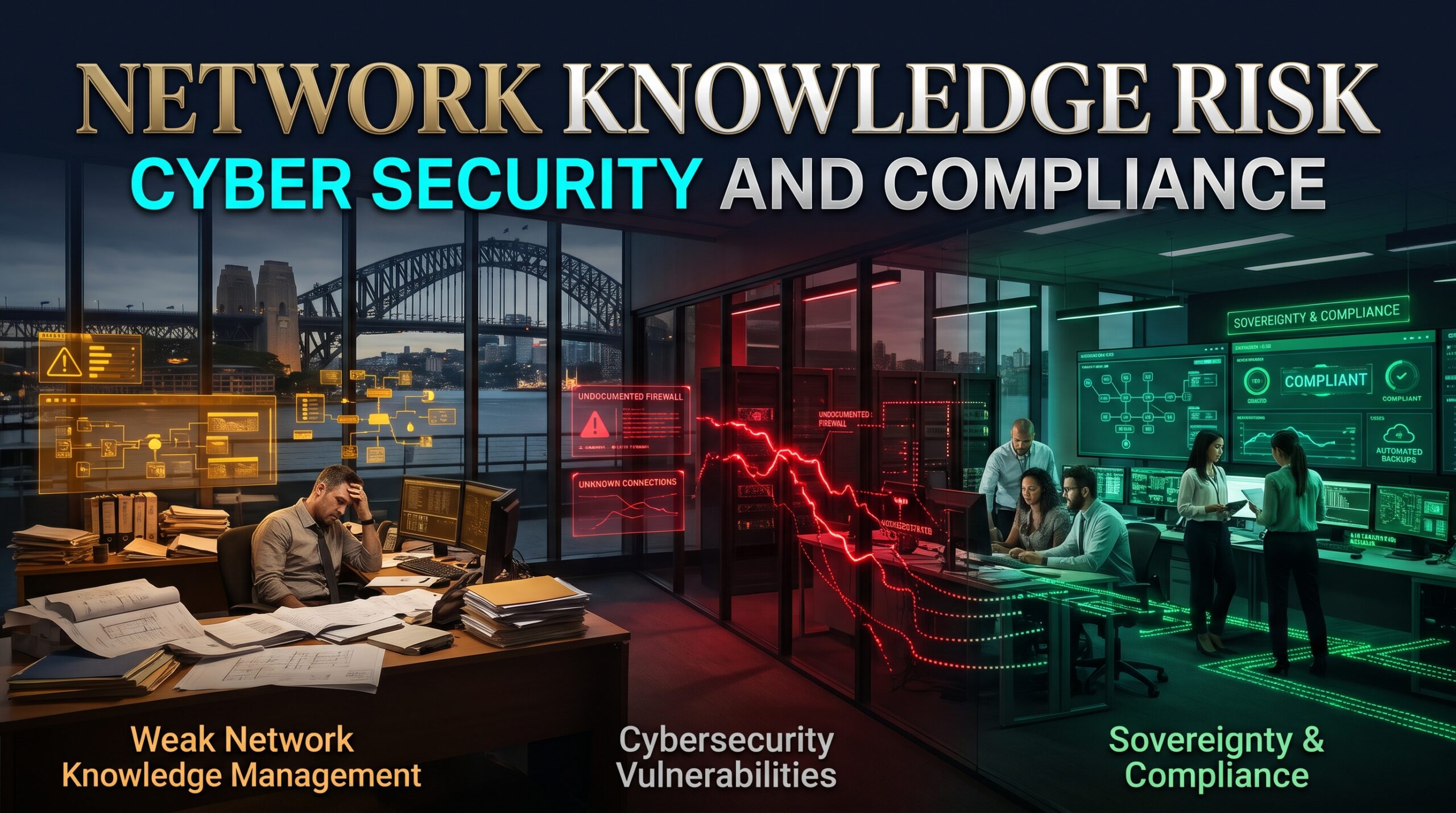
If your business is covered by the Privacy Act 1988, the Office of the Australian Information Commissioner also administers the Notifiable Data Breaches scheme, which can require you to notify affected individuals when an eligible data breach is likely to cause serious harm. Responding quickly depends on knowing exactly how traffic flows through your network and where your data sits. When one person holds that knowledge, a breach during their absence becomes far harder to contain and report properly.
In short, reducing the network knowledge risk is not only good housekeeping. It supports your ability to meet your security and privacy obligations when things go wrong.
How to Reduce the Network Knowledge Risk: A Practical Plan
The good news is that this problem is fixable, and you do not need to rebuild your network to do it. Work through these steps in order.
- Document what exists. Create current network diagrams, an IP address register, a device inventory and a list of critical vendors and contracts. Keep it in a secure, shared location.
- Store credentials properly. Use an approved password manager with shared, audited access, so that critical accounts do not depend on one person’s memory.
- Automate and test backups. Schedule configuration backups for routers, switches and firewalls, and practise a restore at least twice a year.
- Introduce change control. Record what was changed, when and why. A simple change log removes years of guesswork.
- Cross-train at least one other person. Pair your network lead with a colleague on real tasks. Shadowing alone is not enough; the backup person should perform changes under supervision.
- Invest in recognised certification. Structured training gives your team a shared vocabulary and tested skills, which makes handovers far smoother.
- Run a “hit by a bus” drill. Once a year, have your network lead step away for a day and see what the team cannot do. The gaps you find become your next training plan.
How CCNA Certification Closes the Network Knowledge Risk Gap
Documentation tells people what the network looks like today. Training teaches them why it works and how to fix it. That is where the Cisco Certified Network Associate (CCNA) comes in. The CCNA 200-301 exam covers network fundamentals, IP connectivity, IP services, security fundamentals and automation and programmability, which are the exact skills a backup engineer needs.
Our CCNA training course is hands-on and instructor-led, using Cisco devices and simulators such as Cisco Packet Tracer. Learners practise subnetting, VLANs, OSPF routing, spanning tree and troubleshooting in realistic scenarios. The course fee includes the exam voucher, runs as a 5-day intensive or over 5 weeks, and is priced at AUD $1,995. You can read the full CCNA modules, compare the CCNA certification cost in Australia or explore the CCNA bootcamp if you want to move quickly.
For businesses, this changes the network knowledge risk from “one person knows” to “several people can prove they know”. A certified second engineer can step in during leave, review your designs with fresh eyes and help you prepare for CCNA exam preparation milestones if you want to grow the team further. If you are new to the exam, our guides on CCNA exam tips and how to pass CCNA 200-301 are a good place to start.
Certification also gives individuals a clear career path, which helps retention. Cisco’s own Learning Network describes how CCNA leads on to higher-level paths such as CCNP, so a team member who trains with you has a reason to stay and grow with you. You can browse current certification information on the Cisco website.
Network Knowledge Risk Across Australian Cities
The network knowledge risk looks a little different depending on where your business operates, but the answer is always the same: spread the knowledge. Here is how we see it across the country.
Sydney. Finance, professional services and technology firms in the CBD and Parramatta often run complex, high-availability networks maintained by very small teams. Our CCNA course in Sydney is run from Surry Hills for teams that want a certified backup.
Melbourne. From manufacturing in the south-east to healthcare and education across Victoria, many organisations depend on a single network administrator. Join our CCNA course in Melbourne at our West Melbourne centre.
Brisbane. Growth in construction, logistics and government services means Queensland networks are expanding faster than their teams. See our CCNA course in Brisbane at Ann Street.
Perth. Mining and resources businesses often run remote sites on a handful of network specialists, which sharpens the network knowledge risk. Our CCNA training in Perth is available live online or in-house.
Adelaide. Defence, health and education employers can benefit from cross-trained staff. Explore CCNA training in Adelaide, delivered live online or in-house.
Canberra. Federal agencies and their suppliers carry strict security expectations, making shared network knowledge essential. Learn more about our CCNA course in Canberra.
Looking for something closer to home? Our Areas We Offer menu lists every location, and we can also deliver private in-house sessions for your team.
Network Knowledge Risk: Frequently Asked Questions
What is network knowledge risk?
Network knowledge risk is the danger that comes from only one person, or a very few people, understanding how your business network is designed, secured and maintained. If they leave or become unavailable, no one else can support the network confidently.
How do I know if my business has a single point of failure in IT?
If your network could not be repaired, changed or secured by anyone else within a day, you have a single point of failure. Missing diagrams, undocumented passwords and no tested backups are strong indicators.
Is the network knowledge risk only a problem for small businesses?
No. Large organisations can have it too, especially in specialised areas such as WAN design, data centre networking or legacy systems. Small businesses simply feel it sooner because they have fewer people to fall back on.
Does CCNA certification really reduce the risk?
It helps significantly. CCNA training builds verified, hands-on skills across routing, switching, security and automation. Combined with good documentation and change control, it lets a second engineer take over safely when needed.
How long does it take to get CCNA certified?
Most people need around two to four months to prepare, depending on experience. Our intensive format runs over five days, and the part-time option runs across five weeks.
Do Not Wait for Your Network Expert to Leave
The network knowledge risk never announces itself. It waits for a resignation, an illness or a midnight outage. The businesses that handle those moments calmly are the ones that already documented their network, shared their credentials safely and trained a second person to take over.
If your business depends on a single network expert, now is the time to act. Review our CCNA certification overview, read the FAQ or contact our team on 1300 649 299 to discuss group training. You can also book your CCNA course now and turn the network knowledge risk into a strength.