




Network documentation debt is the quiet risk sitting inside almost every IT team. The network works, users are mostly happy, and nobody thinks about the diagrams, address lists and configuration notes, until an outage hits at 2 am and the only person who understood the setup left the company a year ago.
If you work in an Australian IT team, you may already recognise the pattern. Changes get made quickly, documentation gets postponed, and the gap between what is written down and what is actually running grows wider every month. Let us look at why network documentation debt builds up, what it costs, and how to pay it down, with practical skills from a hands-on CCNA training course.
What Is Network Documentation Debt?
You may have heard of technical debt, where quick fixes in code create extra work later. Network documentation debt works the same way. Every undocumented change, missing diagram or outdated address list is a small loan taken against your future time. The interest is paid in slower troubleshooting, riskier changes and more stressful incidents.
Network documentation debt covers anything about your network that a competent engineer would need to know, but cannot find or trust. That includes topology diagrams, IP address plans, VLAN lists, device inventories, firewall rules, cabling records, configuration backups and runbooks.
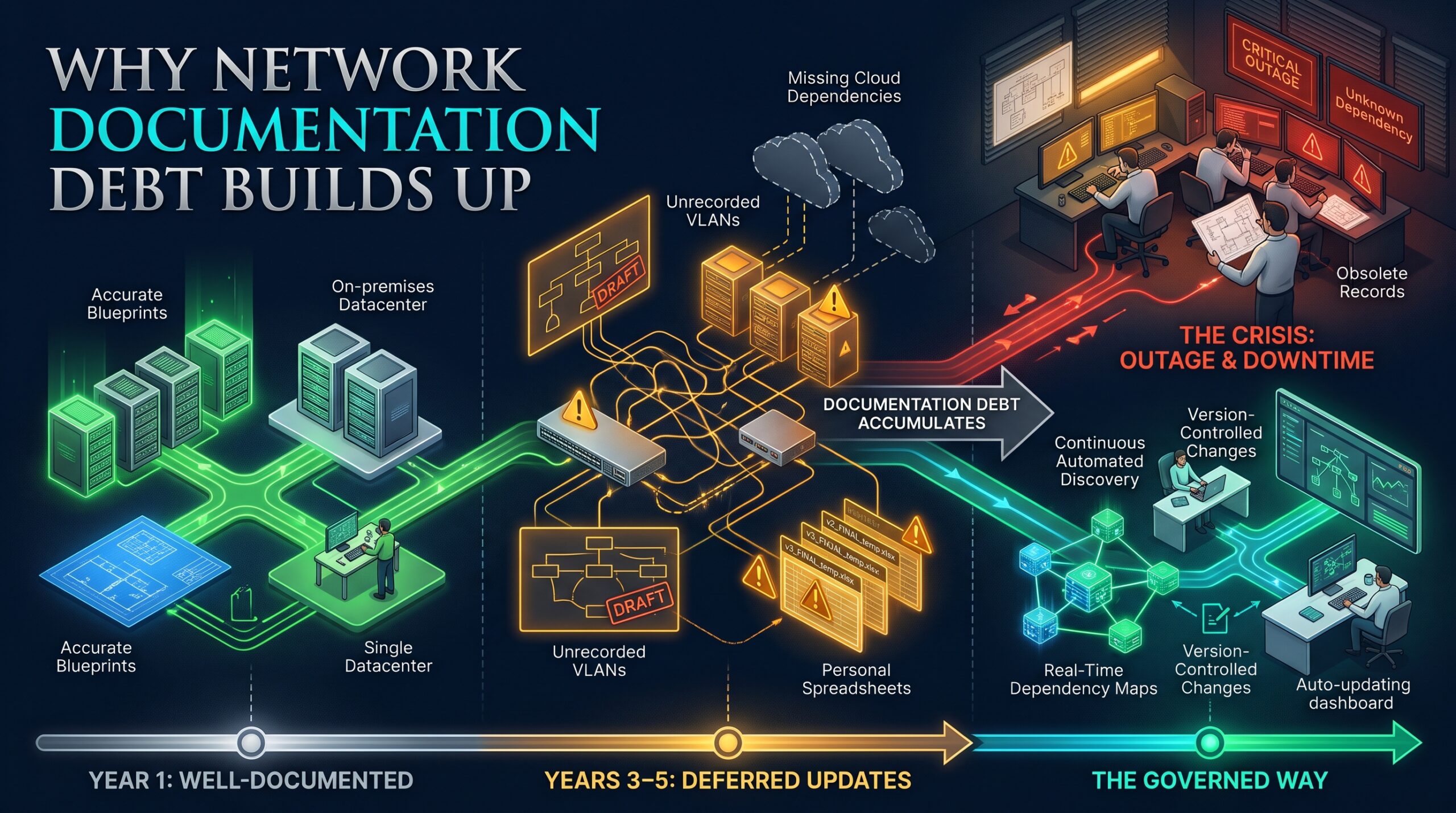
Why Network Documentation Debt Builds Up
Nobody sets out to create a mess. The debt grows through ordinary, understandable habits.
1. Urgent changes beat paperwork
When a fault must be fixed now, writing it up feels like a luxury. Later never comes, and the live network drifts away from the documents.
2. Knowledge lives in a few heads
Many teams rely on one or two experienced engineers who know where everything is. That knowledge is valuable, but it is also fragile. When those people are on leave or move on, the network becomes a puzzle.
3. Documentation has no owner
If everyone is expected to update the records, nobody actually does. Without a named owner and a regular review, network documentation debt grows quietly.
4. Tools and records are scattered
Diagrams sit in one tool, addresses in a spreadsheet, passwords somewhere else and notes in personal folders. Finding the truth takes longer than fixing the problem.
5. Mergers, projects and vendors add complexity
Acquisitions, office moves, cloud migrations and outsourced work all add equipment and connections. Handover documents are often incomplete or never reviewed.
6. Hybrid and cloud networks change faster
Virtual networks, software-defined WANs and cloud connections can be changed in minutes. Static diagrams cannot keep up unless updating them is part of the process.
7. Documentation is treated as the end of a project
Projects are declared complete when the system goes live, not when the records are accurate. The result is a steady flow of new network documentation debt.
The Real Cost of Network Documentation Debt
- Slower fault finding. Engineers spend precious time mapping the network instead of fixing it, so outages last longer.
- Risky changes. If you do not know what depends on a link or rule, every change is a gamble.
- Security blind spots. Unknown devices, forgotten rules and unmanaged ports create openings. Guidance from the Australian Cyber Security Centre and the NIST Cybersecurity Framework both rely on knowing what assets you have.
- Painful onboarding. New staff need weeks of shoulder-tapping to learn what a good diagram could explain in an hour.
- Audit and compliance stress. Proving what is connected and how it is protected is hard without reliable records.
- Higher key-person risk. The network becomes dependent on individuals instead of processes.
Warning Signs of Network Documentation Debt
Check how many of these sound familiar:
- The latest network diagram has not been updated for a year or more.
- Nobody is sure how many switches, access points or VLANs exist.
- Firewall rules have no owner, purpose or review date.
- Engineers say “let me check the device” because the records cannot be trusted.
- New starters rely on one senior engineer to explain how things connect.
- Changes are made first and documented later, if at all.
Two or three ticks mean the debt is already costing you time.
How to Pay Down Network Documentation Debt
You do not need to document everything at once. Start with what matters most and build habits that stop new debt forming.
Step 1: Discover what is really there
Use discovery tools and protocols such as SNMP, CDP and LLDP to list devices, links and software versions. Compare the results to your existing records to see how large the gap is.
Step 2: Pick one source of truth
Choose a single system for your inventory, IP address plan and key records. This might be an IPAM tool, a CMDB or an open-source platform such as NetBox. The goal is one trusted place, not five half-correct ones.
Step 3: Start with the critical path
Document the core network first: internet edge, firewalls, core switching, key VLANs, WAN links and anything customers depend on. Then work outwards.
Step 4: Tie documentation to change management
Make “records updated” part of the definition of done for every change ticket. A change is not finished until the diagram, inventory and notes match reality.
Step 5: Back up and version your configurations
Store device configurations in a version control or backup system so you can see what changed, when and by whom. Automation tools like Ansible can also help standardise and record configuration changes.
Step 6: Standardise naming and labelling
Use clear naming for devices, interfaces, VLANs and cables. Consistent naming makes diagrams and troubleshooting far easier.
Step 7: Write short runbooks
For the most common faults and tasks, create simple step-by-step guides. A good runbook turns a stressful incident into a checklist.
Step 8: Assign owners and schedule reviews
Name a person responsible for each area and review records every quarter. Run a simple test: could a new engineer rebuild the picture of a site from the documents alone?
Why Strong Networking Skills Help Reduce Network Documentation Debt
Good documentation starts with real understanding. Engineers who grasp IP addressing, subnetting, VLANs, routing, switching and network security know what needs to be captured and why. They also troubleshoot faster, because they can reason about how traffic should flow.
Cisco’s CCNA certification builds exactly these foundations, including network fundamentals, IP connectivity, network access, security fundamentals and automation basics. Resources like the Cisco Learning Network and Cisco Networking Academy offer additional study material and community support, and the Australian Computer Society supports ICT professionals across the country.
CCNA Training in Australia to Strengthen Your Network Team
If you want your team to document and manage networks with confidence, structured training helps. Start with our CCNA certification overview, explore the full CCNA modules, or read what is CCNA if you are new to the certification.
When you are ready, you can choose the CCNA training course or the intensive CCNA bootcamp. For exam help, see our guides on CCNA exam preparation, CCNA exam tips and how to pass CCNA 200-301, or check CCNA certification cost in Australia.
Learn in your city or online across Australia:
- CCNA course in Melbourne
- CCNA course in Sydney
- CCNA course in Brisbane
- CCNA course in Perth
- CCNA training in Adelaide
- CCNA course in Canberra
Learn more about us, read the CCNA FAQ, or browse more articles on our networking blog.
Frequently Asked Questions About Network Documentation Debt
What is network documentation debt?
It is the growing gap between how your network is actually built and what your diagrams, inventories and notes say, creating extra risk and extra work over time.
Why is network documentation important?
Accurate documentation speeds up troubleshooting, makes changes safer, supports security and audits, and makes it easier for new engineers to get up to speed.
How often should network documentation be updated?
Ideally every time a change is made, with a scheduled review each quarter to catch anything missed.
What tools can help manage network documentation?
Common options include IPAM and DCIM platforms, CMDBs, diagramming tools, configuration backup systems and automation tools. The best choice is one your team will actually keep current.
Does CCNA training help with documentation?
Indirectly, yes. CCNA gives you a solid understanding of addressing, VLANs, routing and security, so you know what to record and can troubleshoot accurately when records are incomplete.
Final Thoughts: Make Your Network Easier to Trust
Network documentation debt is not a sign of a careless team. It is the natural result of busy people fixing real problems under pressure. But left alone, it turns small incidents into long ones and ordinary changes into risks. Discover what is really there, choose a source of truth, link records to change management and give documentation an owner. Pay a little each week, and the network becomes something your whole team can understand, defend and improve.
Ready to build stronger networking skills? Call 1300 649 299 or contact our team to find the right CCNA course in Melbourne, Sydney, Brisbane, Perth, Adelaide, Canberra or online.