




Network dependency risk is the danger a business carries when almost everything it does relies on a network that very few people truly understand. Payments, phones, cloud apps, security cameras, cloud backups and every laptop in the building all travel across the same switches, links and services. When it works, nobody thinks about it. When it fails, nothing else works either.
This guide explains why network dependency risk is growing, how to spot it in your own organisation, and what practical steps reduce it. It is written for IT managers, business owners and anyone who wants a career in networking.
What Is Network Dependency Risk?
A computer network is no longer a back-office utility. It is the foundation under cloud software, remote work, voice calls, point-of-sale systems and security tools. Network dependency risk is the gap between how much the business relies on that foundation and how well the business understands it.
That gap is easy to miss because networks usually work. Problems stay hidden until a link fails, a configuration changes or the one person who understands the setup is unavailable. Then everyone discovers at the same moment how much depended on something nobody had mapped.
Why Network Dependency Risk Keeps Growing
Several trends have quietly raised the stakes:
- Everything moved online. Cloud applications, video calls and online payments all need stable connectivity.
- Hybrid work. Staff connect from homes, offices and cafes through VPNs, wireless access points and remote access tools.
- More devices. Phones, printers, sensors, cameras and smart building systems all connect to the network.
- Outsourced IT. Managed service providers and carriers run parts of the network, so knowledge is spread across several parties.
- Years of change. Equipment gets added, moved and patched over time, and diagrams are rarely updated to match.
Each trend adds convenience. Together they make network dependency risk larger and harder to see.
Warning Signs of Network Dependency Risk
- Nobody can produce an up-to-date network diagram on request.
- Only one person knows how the core switches, firewall or wireless system are configured.
- Most staff cannot say which business services stop if one internet link or switch fails.
- Equipment is running past its vendor support date.
- Changes are made directly on devices without approval or notes.
- Outages are fixed by trial and error, and the cause is never properly recorded.
- There is one internet connection, one firewall or one critical switch with no backup.
The Hidden Dependencies Behind Network Dependency Risk
Some of the most dangerous dependencies are not the obvious cables and switches. They are small services that everything else quietly relies on:
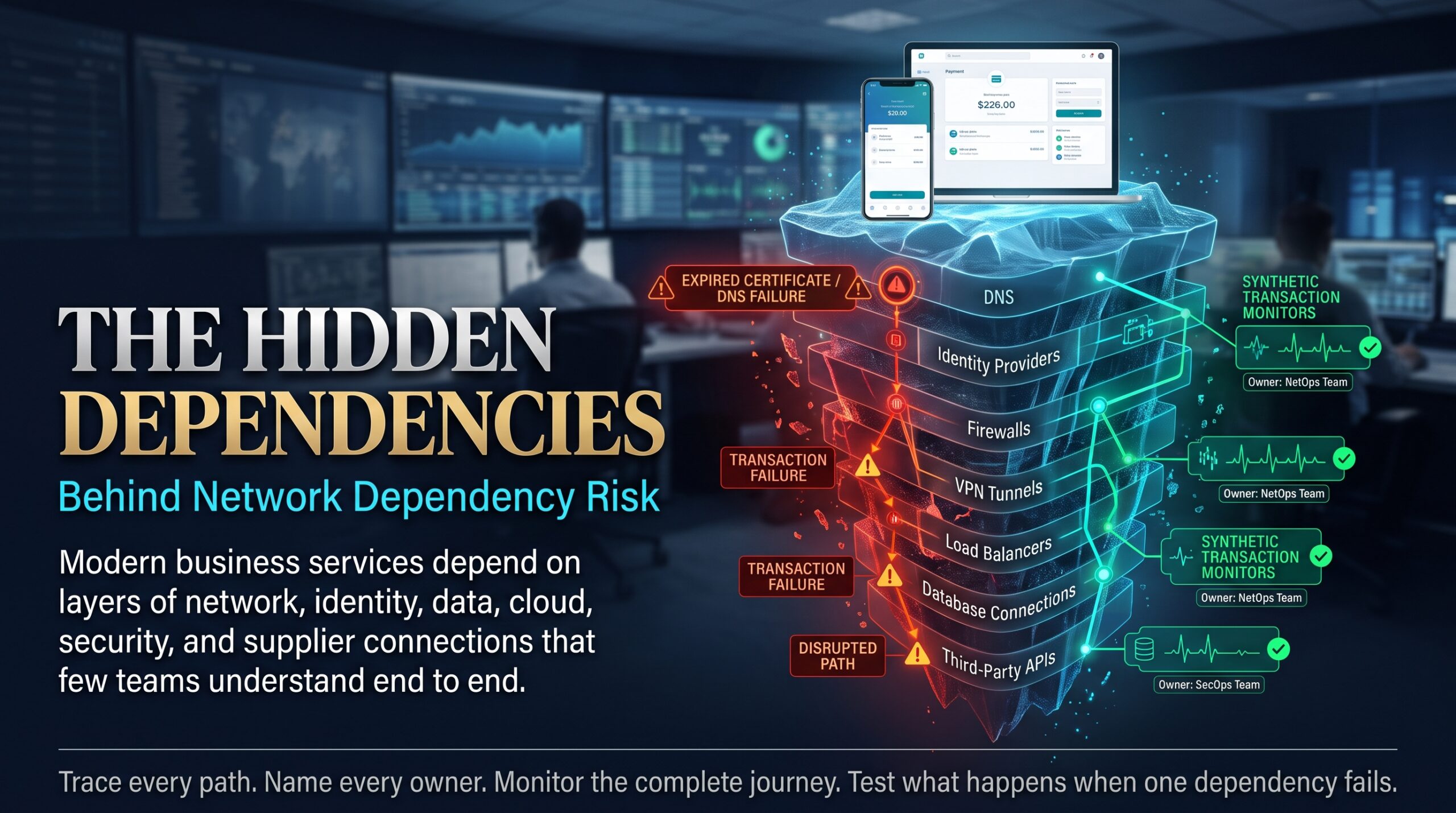
- When name lookups fail, many applications appear down even though the links are fine.
- Devices cannot get addresses and cannot join the network.
- Time synchronisation. Authentication and logging can fail when clocks drift.
- An expired certificate can break secure access across several systems at once.
- Internet and carrier links. One path to the outside world is a single point of failure for every cloud service.
- Power and cooling in comms rooms. A tidy rack means little if one power circuit feeds all of it.
A single point of failure is any component whose loss stops the whole system. Mapping these is the heart of managing network dependency risk.
The Real Cost of Network Dependency Risk
- Staff cannot work, customers cannot buy, and phones and payments may stop together.
- Slow recovery. Without documentation, engineers spend hours working out how things connect before they can fix anything.
- Security exposure. Unmanaged devices, flat networks and outdated equipment give attackers more room to move. The Australian Cyber Security Centre publishes practical guidance on reducing these risks.
- Hidden dependency on individuals. If knowledge sits with one person, their absence becomes an outage risk.
- Poor decisions. Leaders cannot weigh upgrade costs against risk if they cannot see what the network supports.
How to Reduce Network Dependency Risk
You can make meaningful progress without a huge budget. Start with understanding, then add resilience.
- Map your network. Create a current diagram of sites, links, switches, firewalls, wireless and key servers. Update it whenever something changes.
- Map business services to network dependencies. For each critical service, such as payments or phones, list what it needs to work.
- Find the single points of failure. Look for one internet link, one core switch, one firewall or one power feed, and decide what level of backup is worth paying for.
- Build in redundancy where it matters. Options include a second internet link, redundant switches and links, and failover firewalls for critical sites.
- Monitor continuously. Use network monitoring to track link health, device status and unusual traffic, and alert the right people quickly.
- Control change. Back up configurations and require approval and a short record for every change.
- Manage the lifecycle. Track support end dates and plan replacements before equipment becomes a liability.
- Segment the network. Separate guests, staff, servers and devices with VLANs so one problem does not spread everywhere.
- Practise failure. Run a simple tabletop exercise once or twice a year: what happens if the main link or core switch goes down?
- Train more than one person. Make sure at least two people can explain and support the core network.
These steps fit neatly into wider business continuity planning, which prepares the organisation for disruptions of every kind.
A Simple Network Dependency Map
A table like this turns vague worry into a clear list of decisions. Fill one in for your own business:
| Business service | Depends on | Single point of failure? | Backup plan |
| Card payments | Internet link, firewall, DNS | Yes (one link) | Add second link |
| Phone system | Internet, switch PoE, VLAN | Yes (one switch) | Add redundant switch |
| Cloud applications | Internet, DNS, VPN | Partly | Failover link, DNS backup |
| Office wireless | Controller, switches, DHCP | No | Documented, monitored |
The point is not to remove every risk. It is to make risks visible so the business can choose which to accept, which to fix, and which to monitor.
Mistakes That Increase Network Dependency Risk
- Assuming that because the network works, it is well understood.
- Leaving documentation until after an outage.
- Buying redundant hardware without testing failover.
- Relying entirely on a provider without keeping basic in-house knowledge.
- Postponing replacement of ageing equipment because it still works today.
Networking Skills That Reduce the Risk
The most reliable defence against network dependency risk is people who understand how networks work. The Cisco CCNA is a widely recognised starting point for exactly that knowledge. Our training covers:
- Network fundamentals and the OSI model, so you can reason about how data moves.
- IPv4 and IPv6 addressing, subnetting and VLANs, the building blocks of good network design.
- Routing with OSPF and switching with STP, which are central to redundancy.
- Network security and automation basics for safer, more consistent configuration.
Learn more on our CCNA overview and CCNA modules pages, or explore the Cisco CCNA training course and the CCNA bootcamp. New to the topic? Start with what is CCNA.
Preparing for the exam? Our guides on CCNA exam preparation, CCNA exam tips and how to pass CCNA 200-301 can help, and you can check CCNA certification cost in Australia before you enrol.
Learn CCNA in Your City
If you want to understand the networks your business depends on, CCNA training is available in person and live online:
- CCNA course in Melbourne
- CCNA course in Sydney
- CCNA course in Brisbane
- CCNA training in Adelaide
- CCNA course in Perth
- CCNA course in Canberra
Have questions? Visit our FAQ, browse the blog or contact our team.
Frequently Asked Questions About Network Dependency Risk
What is network dependency risk?
It is the risk created when a business relies heavily on a network that is poorly documented, poorly understood or lacking backup, so a single failure can stop key services.
How do you find single points of failure in a network?
Map every critical business service to the links, devices and services it needs, then look for places where one failure would cause an outage, such as a single internet link or core switch.
How often should a network diagram be updated?
Update it whenever the network changes, and review it at least every six to twelve months to make sure it still matches reality.
Does network redundancy remove the risk completely?
No. Redundancy reduces the risk, but only if it is designed well and tested. Untested failover can fail when you need it most.
Which certification helps you understand networks?
The Cisco CCNA covers network fundamentals, IP connectivity, routing, switching, security and automation basics, making it a strong foundation for network roles.
Final Thoughts
Network dependency risk grows quietly because networks usually work. The answer is not to fear the network but to understand it: map what depends on what, remove the obvious single points of failure, monitor what matters and make sure more than one person knows how it all fits together.
Ready to build the skills behind reliable networks? Explore our Cisco CCNA training course and take your next step in networking.