





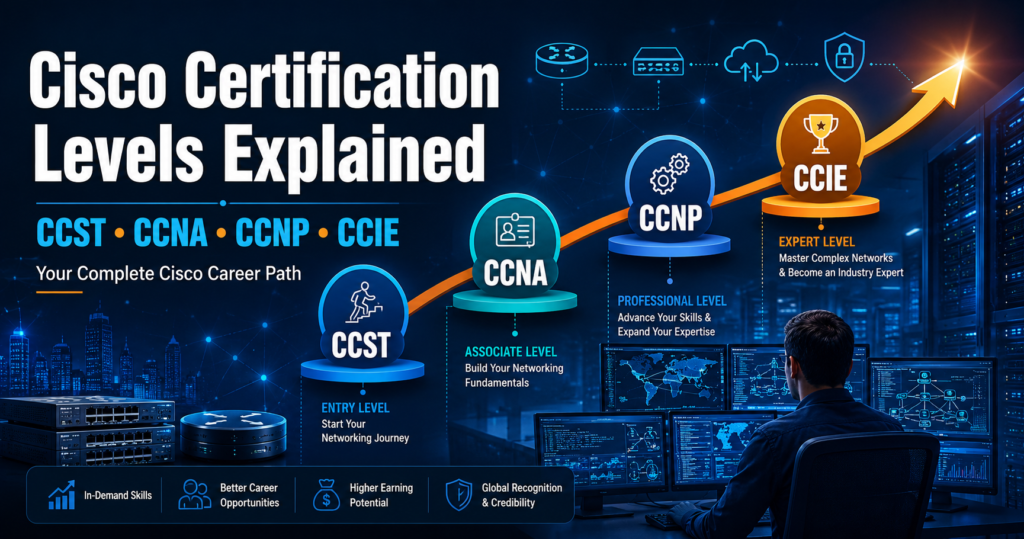
If you’ve started researching a networking career, you’ve probably noticed the Cisco certification levels can look like alphabet soup at first CCST, CCNA, CCNP, CCIE, CCAr. Each one sits at a different rung of the same ladder, and picking the wrong starting point wastes time and money. This guide lays out what each level actually covers, who it’s for, and how the path plays out for IT professionals across Australia, from Sydney and Melbourne to Perth, Brisbane, Adelaide and Canberra.
Why Cisco Restructured Its Certification Levels
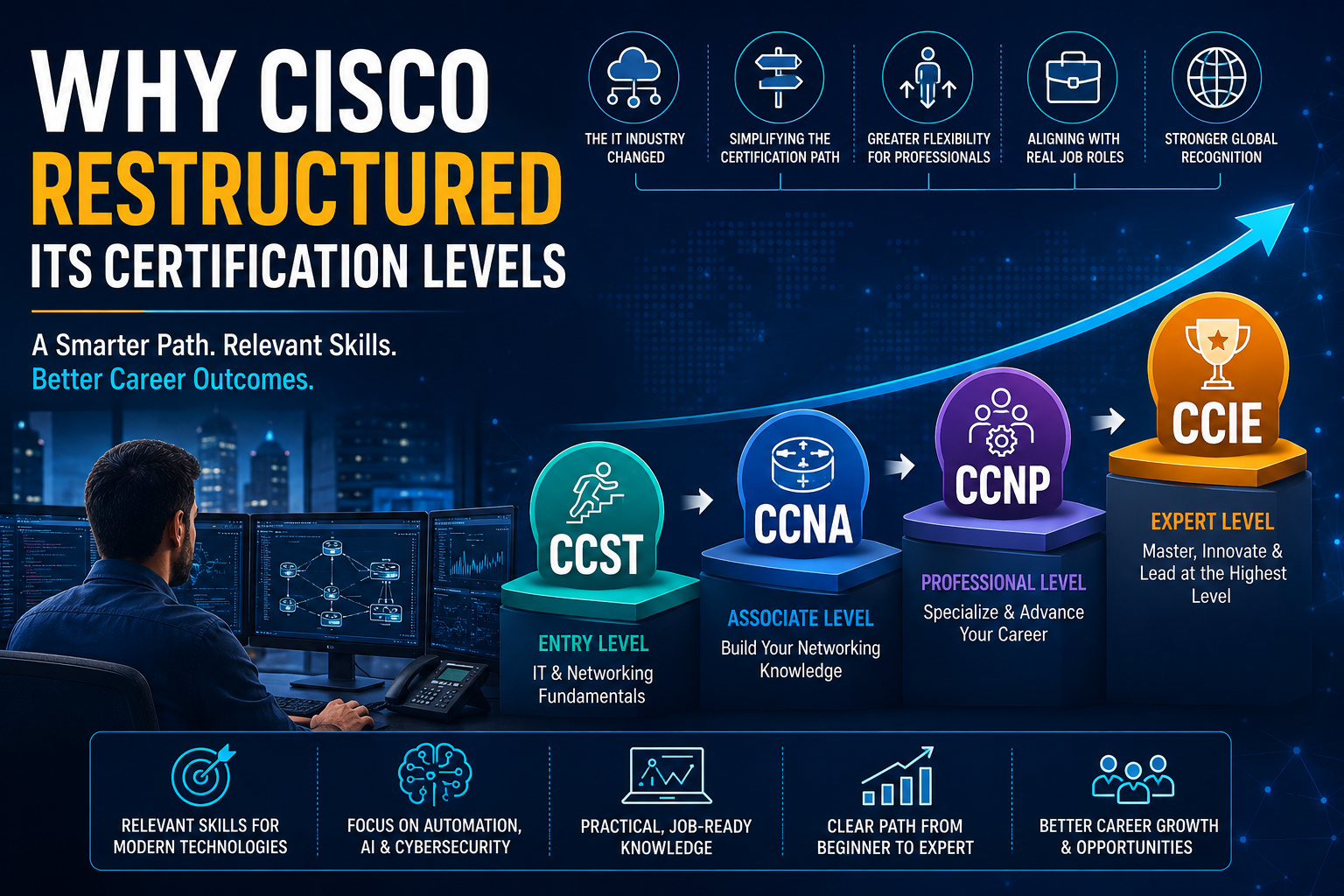
Cisco simplified its certification framework a few years ago, cutting hundreds of overlapping tracks down to five clear tiers: Entry, Associate, Professional, Expert and Architect. The goal was to make it easier for employers to understand what a candidate actually knows, and easier for candidates to plan a realistic study path instead of guessing which exam matters. Understanding these Cisco certification levels up front saves you from enrolling in the wrong course or sitting an exam that’s several steps ahead of where you are.
The Five Cisco Certification Levels, Level by Level
1. CCST — Cisco Certified Support Technician (Entry Level)
CCST is the newest addition to the Cisco certification levels and the easiest entry point for anyone with little or no IT background. It covers core networking concepts, basic troubleshooting, and IT support fundamentals. It suits high school leavers, career changers, and help-desk staff who want a recognised credential before committing to a full CCNA study plan.
2. CCNA — Cisco Certified Network Associate (Associate Level)
CCNA is where most Australian networking careers genuinely begin, and it’s the certification employers ask for most often in junior and mid-level network engineer job ads. A single exam covers IP addressing, routing and switching fundamentals, network security basics, automation and programmability. If you want the full breakdown of what’s involved, our CCNA course page covers the exam blueprint, delivery format and enrolment dates in detail.
3. CCNP — Cisco Certified Network Professional (Professional Level)
CCNP sits one tier above CCNA and is aimed at engineers who already work with enterprise networks day to day. Candidates choose a specialisation Enterprise, Security, Data Centre, Service Provider or Collaboration and sit a core exam plus a concentration exam. Most candidates spend six to twelve months preparing, often while working full-time in a networking role.
4. CCIE — Cisco Certified Internetwork Expert (Expert Level)
CCIE is widely regarded as one of the toughest vendor certifications in IT. It requires a written exam followed by an eight-hour hands-on lab exam, and it’s aimed at senior engineers and consultants who design and troubleshoot complex networks. CCIE holders are rare enough that the credential carries genuine weight with employers and recruiters across Australia’s major tech hubs.
5. CCAr — Cisco Certified Architect (Architect Level)
CCAr sits at the very top of the Cisco certification levels. It’s reserved for architects who design network solutions across an entire enterprise, factoring in business strategy, not just technical design. Very few professionals reach this level, and it typically requires an active CCIE plus years of architecture-level experience.
Cisco Certification Levels at a Glance
| Certification | Level | Prerequisite | Best For | Typical Study Time |
|---|---|---|---|---|
| CCST (Cisco Certified Support Technician) | Entry | None | Beginners, IT support, help desk | 1–2 months |
| CCNA (Cisco Certified Network Associate) | Associate | CCST recommended, not required | Junior network engineers, IT graduates | 3–5 months |
| CCNP (Cisco Certified Network Professional) | Professional | CCNA knowledge assumed | Network engineers, senior admins | 6–12 months |
| CCIE (Cisco Certified Internetwork Expert) | Expert | Deep CCNP-level experience | Senior/lead network engineers, consultants | 12+ months |
| CCAr (Cisco Certified Architect) | Architect | Active CCIE + leadership experience | Enterprise network architects | Multi-year |
Which Cisco Certification Level Should You Start With?
For most people asking about Cisco certification levels for the first time, the honest answer is: start at CCNA unless you have zero IT background, in which case CCST is a sensible warm-up. CCNA alone opens the door to junior network engineer, service desk and NOC roles across Australia. If you’re also weighing up vendor-neutral options, our CCNA vs CompTIA Network+ comparison walks through which one to sit first.
What Cisco Certifications Are Worth in the Australian Job Market
Demand for CCNA and CCNP-certified engineers stays consistent across Sydney, Melbourne, Brisbane, Perth, Adelaide and Canberra, with enterprise, government and managed-services employers all listing Cisco certifications as a screening requirement. If salary expectations are part of your decision, our CCNA salary guide breaks down real earning ranges city by city.
How to Prepare for Each Cisco Certification Level
- CCST: self-study is usually enough, supported by Cisco’s official learning materials.
- CCNA: a structured, instructor-led course speeds up preparation significantly and reduces first-attempt failure rates.
- CCNP: hands-on lab practice matters more than reading — look for training that includes real configuration labs.
- CCIE: expect months of dedicated lab practice on top of the written exam; most candidates study part-time for a year or more.
Where to Train for Cisco Certifications in Australia
Logitrain runs instructor-led CCNA and networking courses across Australia’s major cities Sydney, Melbourne, Brisbane, Perth, Adelaide and Canberra as well as live online delivery for regional students. You can see current course dates and delivery options through Logitrain’s instructor-led networking courses. If you’re also exploring cloud alongside networking, it’s worth reading how these Cisco certification levels compare it with Azure certification pathways, since many engineers now hold both.
Official Cisco Resource
For the full, up-to-date list of exam codes and requirements, Cisco maintains an official certifications overview at cisco.com/certifications, which is worth bookmarking as exam blueprints get periodically updated.
Final Thoughts
The Cisco certification levels form a clear, logical ladder: CCST for beginners, CCNA for your first real networking job, CCNP for engineers ready to specialise, and CCIE or CCAr for the small number who reach true expert status. Most Australian IT careers only need to climb as far as CCNA or CCNP to unlock strong salaries and steady demand the key is starting at the level that actually matches where you are today.