


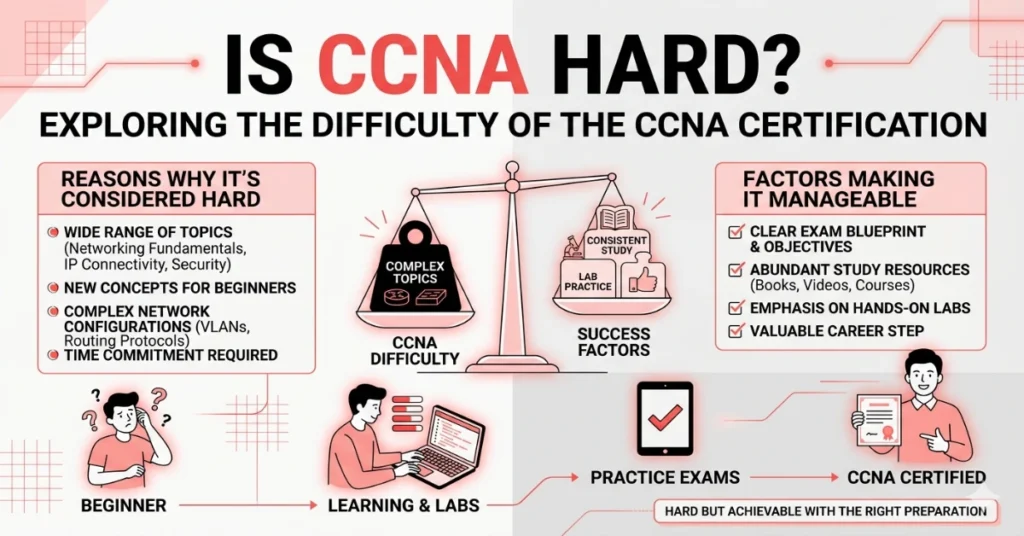
Yes, CCNA is hard for many beginners, but it is not out of reach. The exam is broad, practical, and time pressured, so it feels tough if you go in without a plan. If you are asking Is CCNA hard, the honest answer is this: it is challenging, but very passable when you study the right topics, practise labs, and build your basics first.
A lot of people in Australia struggle with CCNA for the same reason. They try to memorise commands without learning how networks actually work. That approach falls apart fast when the exam gives you routing, switching, security, and troubleshooting in one sitting.
The good news is that CCNA is designed as an associate-level Cisco certification. It tests core networking skills, not expert-level engineering. Cisco says the current CCNA exam is 200-301 v1.1, runs for 120 minutes, and covers six main domains including network fundamentals, IP connectivity, security, and automation.
Why CCNA feels difficult
CCNA feels hard because it mixes theory with hands-on thinking. You do not just need to know what a VLAN is. You need to know why it matters, how to configure it, and what breaks when it is wrong.
The exam covers a wide range of topics. Cisco lists these six domains for CCNA: Network Fundamentals, Network Access, IP Connectivity, IP Services, Security Fundamentals, and Automation and Programmability.
Another reason is time pressure. Cisco network also notes that the exam can include performance-based questions, multiple choice, and drag-and-drop items, so the challenge is not just recall.
For beginners, subnetting often becomes the first wall. After that, switching, OSPF, ACLs, NAT, and wireless security add more layers. None of these topics is impossible on its own. The difficulty comes from learning them together and applying them under exam conditions.
What the CCNA exam actually covers
Here is a simple view of the current blueprint.
| Exam area | Weight | Why it matters |
|---|---|---|
| Network Fundamentals | 20% | Builds your base in IP, cabling, topology, and switching |
| Network Access | 20% | Covers VLANs, trunks, STP, EtherChannel, and wireless basics |
| IP Connectivity | 25% | Focuses on routing tables, static routes, and OSPF |
| IP Services | 10% | Includes NAT, DHCP, DNS, NTP, SSH, and QoS |
| Security Fundamentals | 15% | Tests ACLs, WLAN security, and device access control |
| Automation and Programmability | 10% | Introduces APIs, JSON, controller-based networking, and automation |
Cisco publishes these topic areas and weightings in the official CCNA exam topics guide.
Is CCNA hard for beginners?
For a true beginner, yes, CCNA feels hard at the start. That is normal.
What matters is not where you start. What matters is whether you build the basics in the right order. Beginners who learn network fundamentals first usually do better than those who jump straight to commands.
The exam is fair, but it expects real understanding. Cisco states that CCNA tests knowledge and skills across practical networking domains, not just definitions. So if you are new to IT, expect a learning curve, not a shortcut.
For many Australian students, the challenge is also lifestyle. You may be working full time, studying after hours, or trying to switch careers. In this case, the exam is not just academically hard. It is hard because staying consistent every week is hard.
Book your CCNA Certification today.
Who usually finds CCNA the hardest
CCNA is usually hardest for three groups.
First, people who hate fundamentals. If you rush through IPv4, IPv6, subnetting, and switching, you keep paying for it later. Routing and security make less sense when your base is weak.
Second, people who only watch videos. Video lessons help, but CCNA Certification is a practical certification. If you do not build labs, break configs, and fix them, the knowledge stays shallow.
Third, people who study without a plan. They move from topic to topic, collect notes, and still feel lost. The official blueprint exists for a reason. Cisco even recommends using the topic guide to stay focused and build a structured study plan.
What makes CCNA manageable
CCNA become manageable when you stop treating it like a memory test. It rewards structured study and repetition.
Start with networking fundamentals. Learn how devices talk, how switching works, and how IP addressing fits together. Then move into VLANs, trunks, static routing, OSPF, ACLs, NAT, and wireless. Finish with automation basics.
Lab work matters just as much as reading. Cisco highlights hands-on prep options such as practice exams, Cisco Modeling Labs, and guided learning resources for CCNA preparation. You do not need a full rack at home. You just need regular practice and a habit of testing what you learn.
A simple rule works well: study the concept, lab the concept, then explain it in plain English. If you cannot explain why a command works, you probably do not know it well enough yet.
A study plan that works in Australia
If you work in IT support, admin, or help desk, a realistic CCNA study plan is often 10 to 12 weeks. If you are new, give yourself longer and do not rush the process.
Here is a clean CCNA module structure.
Weeks 1 to 2
Focus on network basics, the OSI model, Ethernet, TCP vs UDP, and IPv4 addressing.
Weeks 3 to 4
Move into switching. Learn VLANs, trunk links, Inter-VLAN routing, STP, and EtherChannel. Build small practice labs again and again.
Weeks 5 to 6
Study IP connectivity,routing tables, static routes, default routes, and single-area OSPF. This area carries the highest weighting on the exam, so it deserves serious time.
Weeks 7 to 8
Cover IP services and security fundamentals. Work on NAT, DHCP, DNS, SSH, ACLs, WLAN security, and device hardening.
Weeks 9 to 10
Finish with automation and programmability. Cisco includes controller-based networking, REST-based APIs, JSON, and automation concepts in the current blueprint.
Final 2 weeks
Review weak spots, sit timed practice exams, and revisit labs you still get wrong. Do not keep learning new things at the last minute. Tighten what you already know.
If you want extra structure, Cisco says candidates can schedule the exam through Pearson VUE, either at an authorised test centre or through online proctoring in most countries. That flexibility helps Australian students who want to book around work or family.
Common mistakes that make CCNA harder
A few mistakes make CCNA feel harder than it needs to be.
Studying passively is the first one. Reading notes for hours is not the same as solving problems. You need retrieval practice, labs, and revision under time pressure.
Ignoring subnetting is another big one. If subnetting is weak, routing becomes slow and frustrating. Fix that early and the rest of the course feels lighter.
Skipping troubleshooting also hurts. The exam expects you to interpret output and spot what is wrong. That skill only grows through hands-on practice.
Cramming at the end rarely works. CCNA is too broad for last-minute panic study. Small, steady sessions beat one big weekend every time.
If you want local support, CCNA Certification Australia offers training for Australian learners and is based at Suite 3, 53 Dryburgh Street, West Melbourne VIC 3003. You can use that support to turn a hard exam into a structured goal.
Frequently Asked Questions
1) Is CCNA hard for beginners?
Answer: Yes, CCNA is hard for beginners, but it is still very achievable.
The exam feels difficult at first because it covers a lot in one certification. Cisco’s current CCNA includes network fundamentals, network access, IP connectivity, IP services, security fundamentals, and automation, all in one exam.
The key is to study in the right order. Start with the basics, practise labs every week, and do not rush the harder topics too early.
2) How long does it take to study for CCNA?
Answer: Most people need a few months of steady study, not just a few weekends.
CCNA is a broad exam, and Cisco expects you to understand both theory and practical skills across six topic areas. That is why most learners need time to build confidence before they book the CCNA exam.
3) Can I pass CCNA without experience?
Answer: Yes, you can pass CCNA without job experience, but you still need hands-on practice.
Cisco does not list a formal job-experience requirement for the CCNA exam. The certification is designed to validate your skills in core networking areas, so what matters most is whether you can actually understand and apply the topics.
4) What is the hardest topic in CCNA?
Answer: For most learners, subnetting and IP connectivity feel the hardest.
Cisco’s official exam topics show that IP Connectivity carries 25% of the exam, which makes it the heaviest domain in the current CCNA blueprint.
That matters because routing questions do not just test memory. They test whether you can read a route, understand why traffic moves a certain way, and spot what is broken.
5) What should I study first for CCNA?
Answer: Start with network fundamentals and IP addressing first.
If your basics are weak, later topics like VLANs, routing, ACLs, and NAT feel much harder than they should.
learn more about CCNA Certification.