



Networking skills are the quiet force behind almost every technology win you read about today. Nobody puts a subnet mask on a billboard, and no one celebrates a well-designed VLAN at the company all-hands. Yet when a cloud migration goes smoothly, when a ransomware attempt is stopped at the edge, or when an AI model replies in half a second instead of five, there is almost always a skilled network professional behind it.
That is why we call it the invisible skill. Cloud, cyber security and artificial intelligence get the headlines, the budgets and the job ads. Networking gets the blame when something breaks and very little credit when everything works. If you are planning an IT career in Melbourne, Sydney, Brisbane, Adelaide, Perth or Canberra, understanding this gap could be one of the smartest moves you make this year.
In this guide you will learn what networking skills really are, how they power cloud computing, cyber security and AI, which roles employers hire for, and how a Cisco CCNA certification can make you job-ready faster than you might expect.
What Are Networking Skills, and Why Do They Stay Invisible?
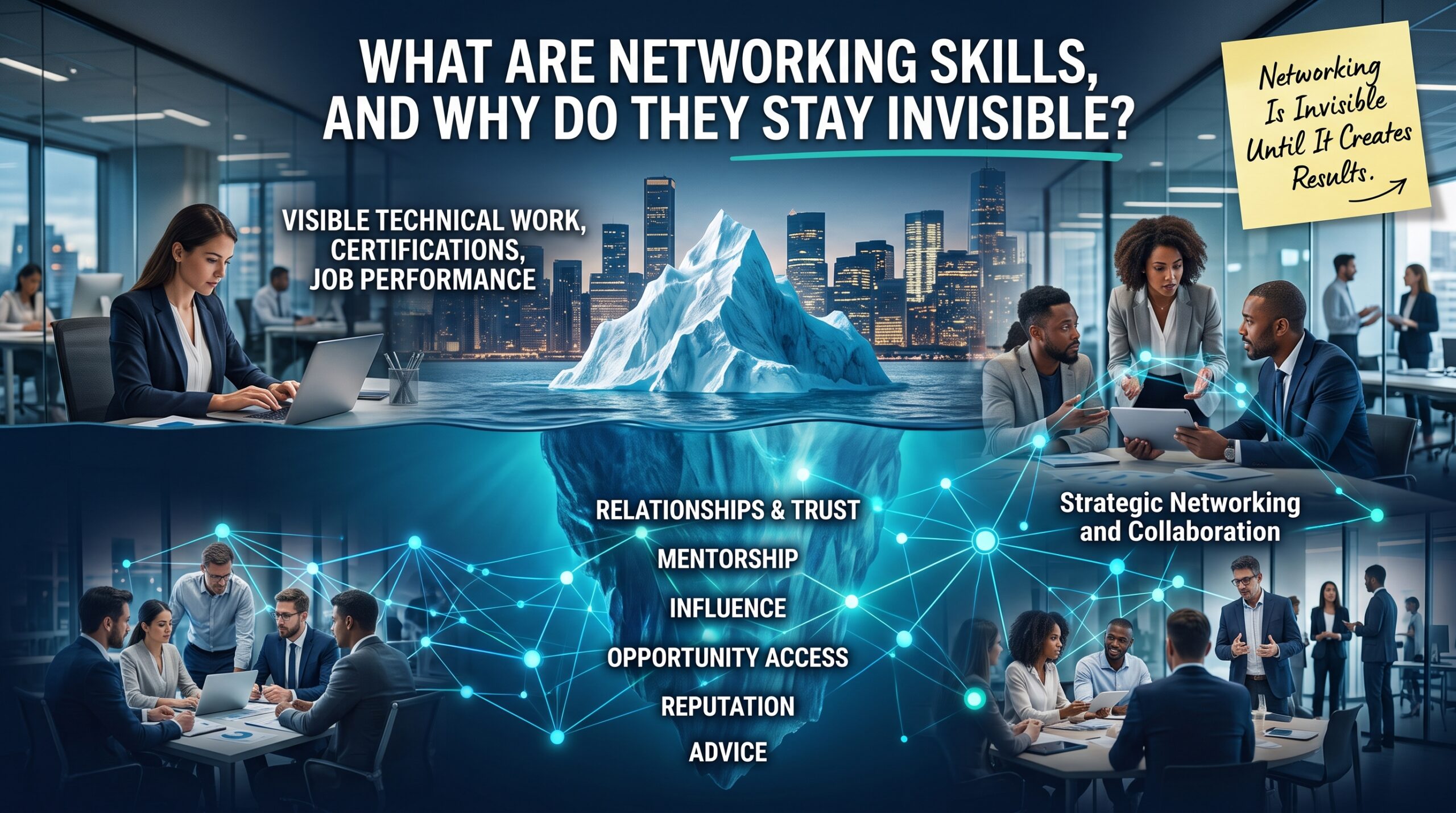
Put simply, networking skills are the ability to design, build, secure and troubleshoot the connections that let devices, applications and people talk to each other. Every email, video call, online purchase, cloud workload and AI prompt travels across a network. When it works, nobody notices. That is the whole point, and it is exactly why the people who build it are so rarely thanked.
The good news is that these networking skills are learnable, structured and recognised worldwide. The core toolkit looks like this:
- IP addressing and subnetting: knowing how devices are identified and grouped.
- Routing and switching: moving traffic efficiently inside a site and between sites.
- VLANs and segmentation: separating traffic so one problem does not become everyone’s problem.
- Network services: DNS, DHCP, NAT and time synchronisation, the small services that everything else depends on.
- Security fundamentals: access control lists, VPNs, device hardening and port security.
- Wireless basics: designing and supporting reliable Wi-Fi for offices and campuses.
- Automation and programmability: using Python, APIs and configuration tools instead of typing the same commands fifty times.
- Troubleshooting: the calm, methodical habit of finding the real cause rather than guessing.
Notice how many of those items overlap with cloud, security and AI work. That overlap is the secret. Master the foundation and every specialist path becomes easier to enter.
Why Networking Skills Matter for Cloud Computing
Cloud platforms such as Amazon Web Services, Microsoft Azure and Google Cloud look like software, but underneath they are enormous networks. Every virtual machine sits inside a virtual network with subnets, route tables, gateways and firewall rules. If you want to see how closely cloud mirrors traditional design, read how a Virtual Private Cloud works on AWS or how Azure Virtual Network is structured. You will recognise the same ideas you learn in CCNA, just wearing a different badge.
Strong networking skills help cloud teams in very practical ways. They decide how an on-premises office connects securely to a cloud environment. They help avoid the classic mistake of overlapping IP ranges when two networks need to join. They explain why an application feels slow for users in Perth when the servers sit on the east coast, and they point to fixes such as better routing, content delivery or load balancing.
Hybrid and multi-cloud designs make this even more important. Most Australian organisations do not live entirely in one place. They run some systems in a data centre, others in two different clouds, and connect branch offices through SD-WAN. Someone has to understand how all of that fits together, and that someone needs solid networking skills, not just a cloud console login.
There is a cost angle too. Data leaving a cloud provider can be charged by the gigabyte, and poorly planned traffic flows quietly inflate the monthly bill. A network-aware cloud engineer spots those patterns early, which makes them valuable to finance teams as well as technical ones.
Networking Skills and Cyber Security: You Cannot Defend What You Do Not Understand
Ask any security leader what separates a good analyst from a great one and you will often hear the same answer: they understand the network. Attacks travel over networks. Malware calls home across networks. Data theft leaves through networks. If you cannot read what normal traffic looks like, you will struggle to recognise abnormal traffic.
This is why cyber security careers and networking go hand in hand. Firewalls, intrusion prevention systems, VPN gateways and zero trust architectures are all built on networking concepts. Segmentation limits how far an intruder can move once they get inside. Access control lists decide what is allowed to talk to what. Logging and flow data tell the story of what happened afterwards.
Frameworks reinforce the point. The NIST Cybersecurity Framework asks organisations to identify, protect, detect, respond and recover, and every one of those functions touches network visibility and control. In Australia, the Australian Cyber Security Centre publishes the Essential Eight mitigation strategies, a practical baseline that many businesses and government agencies are expected to follow. Several of its controls, from patching to restricting administrative privileges, are far easier to apply when your team has strong networking skills.
If you are drawn to security, starting with networking is not a detour. It is the shortcut. People who understand TCP/IP, routing and switching learn firewall policy, packet analysis and incident response with far less friction than people who skipped the fundamentals.
How Networking Skills Power AI Success
AI feels like pure software, but it is also a data movement problem. Training and running modern models means pushing huge volumes of data between storage, servers and accelerators such as GPUs. If the network is slow, congested or badly designed, expensive hardware sits idle waiting for data. That is wasted money, and it is a networking problem, not a model problem.
Inside AI data centres, engineers care about bandwidth, latency, packet loss and how traffic is spread across many links. Outside the data centre, businesses want AI tools to work at the edge, in branch offices, factories, hospitals and retail stores, where reliable connectivity decides whether a use case is practical at all.
Even everyday AI adoption leans on the network. Staff connect to cloud-based assistants through secure gateways. Companies need to control which data leaves the organisation. Monitoring platforms that use machine learning to spot faults rely on clean telemetry from routers, switches and wireless controllers. In every case, professionals with practical networking skills are the ones who make the technology dependable.
The takeaway is encouraging. You do not need a mathematics degree to contribute to the AI era. You need people who can keep data flowing safely, quickly and predictably, and that describes a network professional perfectly.
Networking Skills Jobs in Australia: Roles and Where Demand Shows Up
Employers rarely advertise for “invisible skills”, but they hire for them constantly under job titles you will recognise. Common roles that rely on networking skills include:
- Network administrator and network engineer
- Cloud network engineer or cloud support engineer
- Security operations centre (SOC) analyst
- Systems engineer and infrastructure specialist
- IT support lead and service desk escalation engineer
- Technical consultant for managed service providers
- Data centre and AI infrastructure support technician
Location matters, so here is how the picture tends to look. Melbourne and Sydney have the largest concentration of enterprise, finance, telecommunications and technology employers. Brisbane continues to grow as a hub for infrastructure and government projects. Canberra is closely linked to federal government, defence and cyber security work. Adelaide has a growing defence and digital sector, while Perth’s resources, mining and energy industries depend heavily on resilient networks across remote sites.
Salary ranges change with experience, employer and city, so check current listings on job boards such as Seek before setting expectations. What is consistent is that a recognised credential helps recruiters shortlist you, and that is where certification enters the story.
How a CCNA Certification Builds Networking Skills Employers Trust
The Cisco Certified Network Associate (CCNA) is one of the most widely recognised entry points into IT networking. It validates the knowledge you need to build, manage and troubleshoot small and medium-sized networks, and it is the foundation many professionals use before moving on to CCNP or specialist paths in security and cloud. You can read Cisco’s own overview of the CCNA certification to see the official exam details.
The current exam, 200-301, covers network fundamentals, network access, IP connectivity, IP services, security fundamentals, and automation and programmability. In other words, it lines up neatly with the three themes of this article: cloud, security and AI all depend on that same list.
At ccnacertification.com.au, the CCNA course is instructor-led and hands-on, so you practise on Cisco devices and simulators instead of only reading slides. Here is what the website lists for participants:
- The CCNA 200-301 exam is included in the course fee, and you can sit it at an authorised test centre on the provider’s premises.
- Full-time training runs five days, Monday to Friday, from 9:30 am to 5 pm.
- Part-time options run for five weeks on weeknights or on Saturdays.
- Course material includes the Cisco Press Official Cert Guide Library and practice questions.
- Training is led by an experienced CCIE-certified instructor, and the team says it has trained more than 1,500 Cisco professionals.
Pricing shown on the site starts from $1,649 for the part-time option, with the full-time option listed at $2,199 at the time of writing. Always confirm current fees and dates on the CCNA course page before you book.
If you want to experiment before you enrol, download Cisco Packet Tracer, a free simulator that lets you build virtual networks at home. Even an hour of tinkering will show you how quickly networking skills turn from abstract theory into something satisfying.
CCNA Course Options in Melbourne, Sydney, Brisbane, Adelaide, Perth and Canberra
One reason people delay learning networking is the assumption that training is only available somewhere else. The provider offers CCNA certification training across major Australian cities, as well as in-house corporate delivery and live virtual classes. That means you can choose the format that fits your life:
- CCNA course in Melbourne: ideal for professionals in the CBD, Docklands and surrounding suburbs.
- CCNA training in Sydney: suited to those working in finance, telecommunications and enterprise IT.
- CCNA certification in Brisbane: a strong fit for infrastructure, government and managed services careers.
- CCNA course in Adelaide: useful for the state’s growing defence and technology employers.
- CCNA training in Perth: practical for resources, mining and energy sector IT teams.
- CCNA course in Canberra: well matched to government, defence and cyber security pathways.
- In-house and live virtual CCNA training: for teams that want to upskill together or learn from home.
If you manage an IT team, in-house delivery deserves a look. Training a whole group together creates a shared language for troubleshooting, and that often improves response times more than any new tool can.
A 90-Day Plan to Build Networking Skills From Scratch
You do not need to be a genius, and you do not need years of experience. You need a plan and consistent practice. Here is a realistic path for a beginner:
- Weeks 1 to 2: learn the language. Study the OSI and TCP/IP models, IP addressing and basic subnetting. Practise subnetting daily until it feels automatic.
- Weeks 3 to 5: build your first labs. Use Packet Tracer to configure switches, VLANs and trunk links. Break things on purpose, then fix them.
- Weeks 6 to 8: master routing. Work through static routing, OSPF and default routes. Draw every topology by hand before you configure it.
- Weeks 9 to 10: add services and security. Configure DHCP, NAT, access control lists and basic device hardening.
- Weeks 11 to 12: connect to the modern world. Explore network automation, REST APIs and how traditional networks link to cloud environments.
- Week 13: sit the exam. Take timed practice tests, review weak areas and book the CCNA 200-301 with confidence.
If self-study feels lonely, structured instructor-led training compresses this timeline and gives you someone to ask when a lab refuses to cooperate. That is the main value of a hands-on CCNA course compared with studying alone.
Frequently Asked Questions About Networking Skills
What are networking skills?
Networking skills are the technical abilities used to design, configure, secure and troubleshoot computer networks, including IP addressing, routing, switching, network services and basic security.
Are networking skills still relevant in the age of cloud and AI?
Yes. Cloud platforms and AI systems run on networks, so they depend on reliable connectivity, segmentation and security. Many cloud and AI problems are actually network problems in disguise.
Do I need experience before taking a CCNA course?
There are no formal prerequisites. Basic computer knowledge and some familiarity with networking concepts help, but the course is designed to guide people who are starting out.
How long does it take to prepare for the CCNA exam?
It depends on your background and study time. Intensive full-time classes take about a week, while part-time options spread the same material over several weeks, followed by your own practice.
Can networking skills lead to a cyber security career?
Absolutely. Understanding traffic, protocols and segmentation makes it much easier to move into security operations, firewall administration and incident response.
Final Thoughts: Make the Invisible Skill Your Advantage
Cloud, cyber security and AI will keep changing, and new tools will appear every year. The connections beneath them will not disappear. Professionals who invest in networking skills gain a foundation that holds its value through every technology shift, and a clear way to stand out in a crowded job market.
Ready to take the first step? Explore the CCNA certification course at ccnacertification.com.au, compare Melbourne, Sydney, Brisbane, Adelaide, Perth, Canberra, in-house and live virtual options, and book the session that suits you. Your future team will probably never notice the network you build, and that is the best compliment it can get.