





VLAN sprawl is what happens when a network that started with a handful of tidy segments slowly turns into dozens, then hundreds, of VLANs that nobody can fully explain. Each VLAN made sense on the day it was created. Years later, the people who created them have moved on, the purpose is forgotten and the network diagram is a polite fiction.
If you have ever opened a switch configuration and found VLAN names like “TEMP2”, “NEWOFFICE_OLD” and “DO_NOT_DELETE”, you already know the feeling. Network segmentation is supposed to make a network safer and easier to manage. VLAN sprawl does the opposite: it makes the network harder to understand, harder to troubleshoot and harder to secure.
This article explains how VLAN sprawl develops, why segmentation becomes harder to follow over time, what it costs and how to bring order back without breaking production. It is written for network engineers, IT managers and anyone preparing for a Cisco networking career in Australia.
What Is a VLAN, and Why Do We Segment Networks?
A virtual LAN, or VLAN, lets you divide one physical switch network into separate logical networks. Devices in one VLAN cannot talk directly to devices in another unless traffic is routed between them. The tagging standard behind this is IEEE 802.1Q, which allows up to 4,094 usable VLAN IDs.
Organisations use network segmentation for good reasons: keeping broadcast traffic contained, separating staff from guests, isolating voice and security cameras, protecting payment or clinical systems and limiting how far an attacker can move if one device is compromised. Done well, segmentation is one of the most effective and affordable controls in networking.
The word “done well” is the catch. Segmentation needs to be designed, documented and maintained. VLAN sprawl is what you get when it is only ever added to.
What Is VLAN Sprawl?
VLAN sprawl is the uncontrolled growth of VLANs across a network, usually without matching growth in documentation, ownership or clean-up. It is not about a specific number. A network with 20 well-documented VLANs is healthy. A network with 20 VLANs where nobody knows what half of them do already has VLAN sprawl.
The key signal is not size but understanding. When engineers can no longer answer “what is this VLAN for, who uses it and what is allowed to reach it?”, the segmentation has stopped doing its job, even if every VLAN is technically still working.
Why VLAN Sprawl Happens: How Segmentation Becomes Harder to Understand Over Time
VLAN sprawl rarely comes from one bad decision. It grows from many reasonable ones:
- A new VLAN for every request. Each project, application, vendor or department asks for its own segment, and creating one is quick. Removing one feels risky, so it never happens.
- Temporary becomes permanent. A VLAN created for a migration, a pilot or an event is left in place after the work finishes.
- No naming or numbering standard. Without a plan, VLAN IDs and names are chosen on the day by whoever is working, so the same ID can mean different things at different sites.
- Mergers and site growth. Acquired networks and new offices bring their own VLAN schemes, which are layered on top rather than redesigned.
- Trunks that allow everything. On Cisco switches, trunk ports allow all VLANs by default. If allowed lists are never tightened, every VLAN spreads everywhere.
- Rules pile up with the VLANs. Each segment gets its own gateway interface, DHCP scope and access rules. Over time, inter-VLAN permissions grow into a web nobody dares to edit.
- Documentation drifts. Diagrams and spreadsheets are updated when someone has time, which is rarely. The running configuration becomes the only real source of truth.
- Knowledge walks out the door. When the engineer who understood the design leaves, the reasoning leaves with them.
What VLAN Sprawl Looks Like in Practice
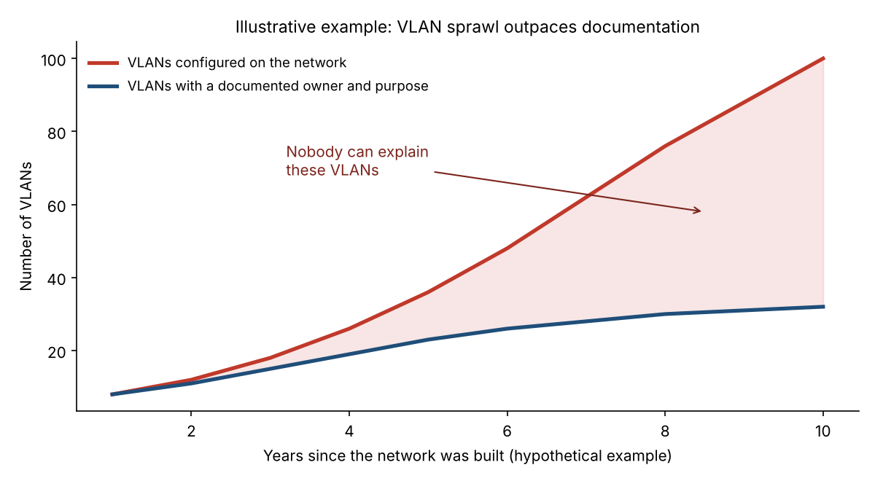
Here is a deliberately simple, hypothetical example. A mid-sized organisation builds its network with eight VLANs: staff, servers, voice, guest, printers, management, cameras and a small test network. Over eight years it adds VLANs for a warehouse system, a vendor remote-access project, two acquisitions, a building upgrade, IoT sensors and many short-lived tests.
The network now has more than eighty VLANs. Thirty are well understood. The rest are a mixture of retired projects, duplicates and segments whose original owners have left. A firewall review finds permissive rules between several of them that nobody can justify, and a simple change to one trunk takes a week of careful checking because no one is sure what depends on it.
Nothing is broken. That is exactly why VLAN sprawl persists: it hurts slowly, and no single day feels like the day to fix it.
Warning Signs of VLAN Sprawl
Use this checklist on your own network:
- You have VLANs with no owner, no documented purpose or vague names such as “temp” or “misc”.
- Different sites use the same VLAN ID for different things, or different IDs for the same thing.
- Trunks carry every VLAN because the allowed list has never been trimmed.
- Retired VLANs still have gateway interfaces, DHCP scopes or firewall rules.
- Troubleshooting a simple connectivity issue means tracing through several undocumented segments.
- The network diagram is out of date, or nobody has opened it in a year.
- Engineers avoid making changes “in case something breaks”.
The Real Cost of VLAN Sprawl
The first cost is time. Every fault takes longer to diagnose in a network nobody fully understands, and every change needs extra checking. The second is risk. A segmentation design is only as strong as its rules, and overly permissive inter-VLAN access can quietly turn a “segmented” network into a flat one.
There are further costs that are easy to underestimate:
- Security exposure. Forgotten segments, unused ports and old trunks widen the attack surface. The Australian Cyber Security Centre’s guidance at gov.au regularly emphasises segmentation and good network hygiene.
- Audit and compliance pain. Reviewers want to see which systems are isolated and why. VLAN sprawl makes that evidence hard to produce.
- Spanning tree complexity. On Cisco switches running per-VLAN spanning tree, more VLANs mean more topology instances to design and troubleshoot. The Spanning Tree Protocol is already a favourite source of outages when poorly managed.
- Address and DHCP clutter. Each VLAN usually has its own subnet and scope, so sprawl drags IP planning into the mess too.
- Slow onboarding. New engineers need weeks, not days, to learn what the network really does.
How to Fix VLAN Sprawl Without Breaking the Network
You do not need a risky rebuild. A careful, staged clean-up works for most organisations:
- Take inventory first. List every VLAN on every switch, where it is trunked, which ports use it, which gateway interface and DHCP scope belong to it and which firewall rules reference it. Commands such as show vlan brief and show interfaces trunk are a starting point, and network documentation or IPAM tools help you keep the result.
- Identify an owner and a purpose for each VLAN. If you cannot find one, treat it as a candidate for review rather than for instant deletion.
- Agree a numbering and naming standard. Group VLAN IDs by function or security zone, use clear names and apply the same scheme at every site.
- Design around zones, not projects. Aim for a modest number of well-defined zones, such as users, servers, voice, guest, IoT and management, rather than a segment for every request.
- Prune trunks and unused VLANs. Restrict allowed VLANs on trunk links to what is needed. Shut down unused ports, and review features such as dynamic trunking and VTP, which can cause surprises if left in default modes.
- Review inter-VLAN rules. For each remaining segment, ask what really needs to talk to what, and remove broad permits that exist only because they were quicker at the time.
- Retire in stages. For a VLAN that appears unused, watch it for a period, remove it from trunks first, then remove gateways and rules, and keep a rollback plan.
- Keep the source of truth current. Store configurations in version control where possible and use basic network automation to push consistent changes.
- Review on a schedule. Put a quarterly VLAN review on the calendar and give someone the job of owning it.
For larger or newer networks, technologies such as routed access layers, VRFs and software-defined segmentation can reduce reliance on huge Layer 2 designs. They bring their own learning curve, so they work best once the fundamentals are solid.
CCNA Training That Builds the Skills to Control VLAN Sprawl
Every fix above rests on core networking knowledge: VLANs, trunking, IP addressing, routing, spanning tree and security basics. That is exactly what the Cisco CCNA covers. Here is how our CCNA Certification Australia pages can help:
- What is CCNA and the CCNA certification overview explain the credential and who it suits.
- CCNA certification modules outline the curriculum, including IPv4/IPv6, subnetting, VLANs, OSPF routing, STP switching, network security and automation basics.
- The CCNA training course is hands-on, using Cisco Packet Tracer simulations, with classes in full-time and part-time formats.
- The CCNA bootcamp suits learners who want an intensive pathway.
- CCNA exam preparation, CCNA exam tips and our guide on how to pass CCNA 200-301 help you get ready for the exam.
Wondering about price? See our page on CCNA certification cost in Australia. You can also browse more practical articles on the CCNA blog.
VLAN Sprawl Across Australian Cities
VLAN sprawl is a national problem, with local flavour. In Sydney, finance and technology organisations often run large, fast-changing networks with many project-driven segments. Melbourne healthcare, retail and education networks tend to grow across many sites, which multiplies inconsistent VLAN schemes.
In Brisbane, infrastructure and project-based businesses create and retire networks constantly. Perth resources and energy companies connect corporate, operational and remote-site networks. Canberra agencies work under strict segmentation and audit expectations, and Adelaide organisations of every size inherit the same long-lived configurations.
Wherever you are, CCNA training is available through in-person classes in major cities and live online options across Australia.
Frequently Asked Questions About VLAN Sprawl
What is VLAN sprawl?
VLAN sprawl is the uncontrolled growth of VLANs on a network without matching documentation, ownership or clean-up, so that nobody can fully explain what each VLAN is for.
How many VLANs is too many?
There is no fixed number. The test is whether every VLAN has a clear owner, purpose and rule set. If engineers cannot explain most of them, you have too many for your current level of control.
Is it safe to delete an unused VLAN?
Usually, but do it in stages. Confirm no ports, trunks, gateway interfaces, DHCP scopes or firewall rules depend on it, remove it from trunks first, and keep a rollback plan.
What is the difference between a VLAN and a subnet?
A VLAN is a Layer 2 broadcast domain, while a subnet is a Layer 3 IP address range. In most designs each VLAN maps to one subnet, which is why VLAN sprawl also creates IP address and DHCP clutter.
Does the CCNA cover VLANs?
Yes. VLANs, trunking, routing, spanning tree and network security basics are part of the CCNA 200-301 content, and our CCNA modules page lists what is covered.
Final Thoughts: Keep Segmentation Understandable
VLAN sprawl is not a failure of skill. It is what happens to every network that is added to faster than it is tidied. A clear numbering plan, an owner for every segment and a regular review are enough to keep segmentation useful for years instead of confusing for decades.
If you want to build the networking skills that keep VLAN sprawl under control, contact our course advisors or call 1300 649 299, and take a look at our CCNA certification courses.