




Python for network engineers has moved from a nice-to-have to a genuine career differentiator. In 2027, networks are bigger, more software-defined, and more automated than ever, and CCNA-certified professionals who can only configure devices manually through the command line are starting to fall behind peers who can also script the repetitive parts of the job. This guide explains exactly why Python for network engineers matters, what it actually replaces day to day, and how CCNA professionals can start learning it without becoming full-time software developers.
If you’ve completed, or are working toward, your CCNA certification, this article shows you exactly where Python for network engineers fits into your next career step.
What Is Network Automation, and Why Does It Matter in 2027?
Network automation means using scripts and tools to configure, monitor, and troubleshoot network devices instead of doing every task manually through the CLI, one device at a time. As Australian organisations run larger, hybrid and multi-site networks, manually logging into dozens or hundreds of routers and switches to make the same change is slow and error-prone. Automation lets one engineer safely make consistent changes across an entire network in minutes, not days.
Why Python Is the Language of Choice for Network Automation
Python is readable, has a huge library ecosystem, and was the language most networking vendors, including Cisco, built their automation tooling around. Unlike general software development, network automation in Python doesn’t require deep computer-science knowledge most working scripts are built from simple loops, conditionals, and a handful of purpose-built libraries.
How Python Fits Into a CCNA Skill Set
CCNA already teaches the concepts that make Python for network engineers useful: IP addressing, VLANs, routing, and device configuration. Python doesn’t replace that knowledge it gives you a faster way to apply it. Understanding what a configuration command does (from CCNA) is what makes automating it with Python safe and effective, rather than just copying scripts you don’t understand.
Real Tasks Python Automates for Network Engineers
- Backing up device configurations across every switch and router automatically, on a schedule
- Pushing the same VLAN or ACL change to dozens of devices in one run instead of one at a time
- Auditing devices for configuration drift or non-compliant settings
- Pulling interface status, CPU and bandwidth data for reporting and capacity planning
- Generating and validating configuration templates before they’re deployed
Popular Python Libraries for Network Engineers
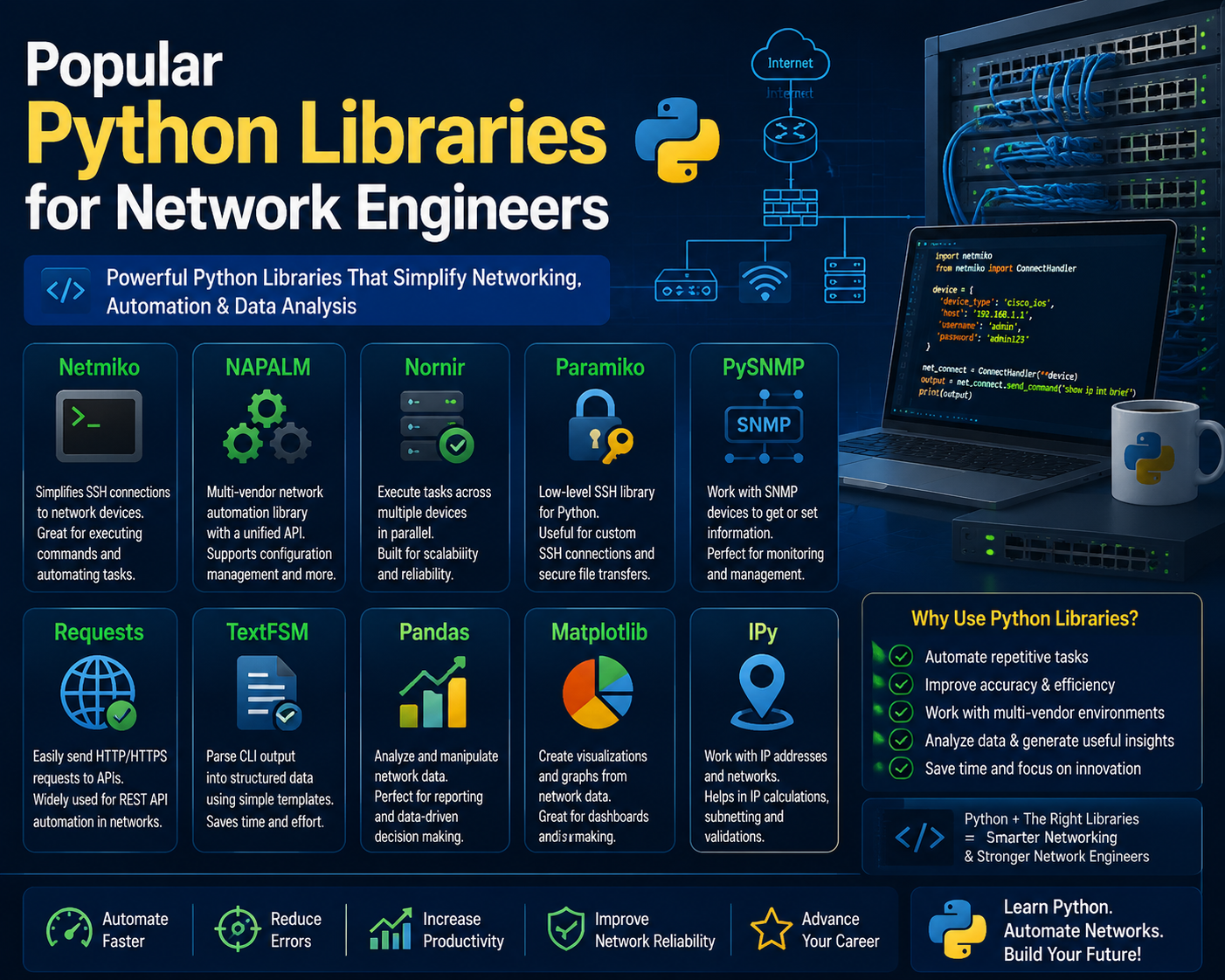
| Library | What It’s Used For |
| Netmiko | Simplifies SSH connections to Cisco routers and switches for running and pushing configuration commands |
| NAPALM | Provides a consistent way to read state and push configuration across different vendor devices |
| Paramiko | A lower-level SSH library that Netmiko and other tools are built on top of |
| Nornir | An automation framework for running Python tasks across many devices in parallel |
| Requests | Calls REST APIs on modern network platforms and controllers |
CCNA vs CCNA + Python: Career and Salary Impact
A CCNA certification alone qualifies you for roles like Network Support Technician, Network Administrator and Junior Network Engineer. Adding working Python skills opens the door to network automation engineer, DevNet-associated roles, and senior network engineer positions, because employers increasingly expect at least basic scripting ability once you move past entry-level support work. It’s one of the clearest ways to stand out once you’ve completed your CCNA training course and are applying for your next role.
How to Start Learning Python as a CCNA Professional
Step 1: Learn Core Python Basics
Variables, loops, functions and basic file handling this takes most CCNA professionals a few weeks of consistent, short study sessions, using free resources like Python’s own documentation.
Step 2: Automate One Real, Small Task
Start with something practical, like pulling the running configuration from a single lab router using Netmiko. A small working script builds more confidence than hours of theory.
Step 3: Practice in a Lab Environment
Use Cisco Packet Tracer or a virtual lab to safely test automation scripts before ever touching production devices. This is the same hands-on approach we use throughout our CCNA bootcamp and course modules.
Step 4: Explore Cisco DevNet
Cisco’s own DevNet platform offers free sandboxes, learning tracks and documentation built specifically for network engineers learning automation and APIs.
Where Python Fits After CCNA
For most CCNA professionals, Python and automation sit alongside not instead of the traditional Cisco certification path. Many engineers pair growing Python skills with progression toward CCNP, or with Cisco’s DevNet-focused certifications, as their role shifts from manual configuration toward automation and network programmability.
Build Your Networking Career in Australia
Strong Python and automation skills start with strong networking fundamentals. Our instructor-led CCNA certification training covers routing, switching, security and automation basics, with hands-on labs delivered from local centres in Sydney, Melbourne, Brisbane, Adelaide, Perth and Canberra, as well as online nationwide. You can review the full CCNA course modules, check the CCNA certification cost, or get in touch to find a class that suits your schedule.
Frequently Asked Questions
Do I need to know Python to pass the CCNA exam?
No. The CCNA 200-301 exam includes only automation and programmability fundamentals a working understanding of concepts, not hands-on Python coding.
How long does it take a CCNA professional to learn Python?
Most CCNA professionals can learn enough Python to automate real, simple network tasks within 4 to 8 weeks of consistent, short practice sessions.
Is Python necessary for entry-level networking jobs?
Not for most entry-level roles, but it’s increasingly listed as a preferred or bonus skill, and it becomes more important as you move into senior or automation-focused roles.
What should I learn first: CCNA or Python?
CCNA first. Networking fundamentals give Python automation its context and purpose without them, scripts are just commands you don’t fully understand. Our CCNA training is built to give you that foundation before you move into automation.
Conclusion
Python for network engineers isn’t replacing CCNA skills it’s extending them. In 2027, CCNA professionals who add even basic Python and automation skills to their toolkit are better positioned for promotions, automation-focused roles, and the next stage of their networking career. Explore our CCNA training courses to build the networking foundation that makes Python automation genuinely useful, or read more on our blog about where networking careers are heading next.